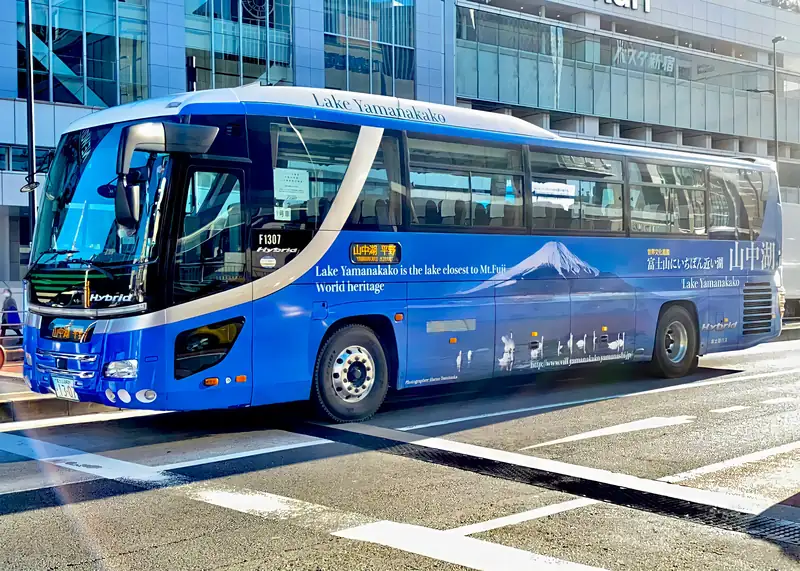
The easiest way from Tokyo to Lake Yamanaka is the direct highway bus from Busta Shinjuku. 27 buses a day reach Yamanakako Asahigaoka in 2 h 14 to 2 h 22, for up to ¥2,650 (¥2,350 online). Trains need a change to a local bus at Fujisan Station or Gotemba. Driving takes about 1 h 30.
The simplest way from Tokyo to Lake Yamanaka is the highway bus from Busta Shinjuku, the bus terminal on the fourth floor above Shinjuku Station’s South Exit. In October 2026, 27 buses a day ran through to Yamanakako Asahigaoka, the bus terminal on the lake’s south shore, in 2 hours 14 to 2 hours 22. No train reaches the lake: rail routes end at Fujisan Station or Gotemba, and a local bus covers the last 30 to 40 minutes. By car it is about an hour and a half.
| Route |
Time to the lake |
Fare (adult, one way) |
Change |
| Highway bus, Busta Shinjuku |
2 h 14 to 2 h 22 to Asahigaoka |
Up to ¥2,650, ¥2,350 online |
None |
| Highway bus, Tokyo Station |
2 h 35 to Asahigaoka |
¥2,700 |
None (3 a day) |
| Fuji Excursion + local bus |
About 1 h 55 by train, then about 30 min by bus |
¥4,010 to ¥4,200 train, plus bus |
Fujisan Station |
| JR via Otsuki + Fujikyu + bus |
About 2 h 45 |
Not published as one fare |
Otsuki, Fujisan Station |
| Odakyu “Fujisan” + bus |
About 2 h 20 |
Check Odakyu |
Gotemba |
| Car |
About 1 h 30 |
Expressway tolls |
None |
Checked October 2026 on the Fujikyu Bus Shinjuku route page, the Fujikyu Bus Tokyo Station page, Fujikyu Railway and the Yamanakako tourist association’s access page. Bus fares to the lake are printed only for Hirano (Shinjuku) and Asahigaoka (Tokyo Station). Train-plus-bus times are the tourist association’s.
Shinjuku to Lake Yamanaka by bus
This is the route most people should take. Fujikyu Bus and Keio Bus share the line, and every seat is reserved. Sales open on the same date one month before travel, online through Fujikyu’s booking site or by phone (phone lines open at 9:00 on the first day only). Buy the ticket at least 10 minutes before the bus leaves. Fujikyu’s page does not say how quickly buses fill, so if your date is fixed, book when sales open.
The fare to Yamanakako Hirano, the last stop, is ¥2,650, or ¥2,350 if you pay online. Children pay half. The page lists no separate fare for Asahigaoka.
Not every Shinjuku bus goes to the lake. Of the 58 daily departures, 27 continue past Kawaguchiko and Fujisan Station to Yamanaka, and 17 run all the way to Hirano. The first lake bus leaves Shinjuku at 07:15 and reaches Asahigaoka at 09:29; the last leaves at 20:15 and arrives at 22:29. Coming back, 25 buses a day leave Asahigaoka for Shinjuku, from 06:25 to 19:30, taking 2 hours 20 to 2 hours 30.
Which stop to get off at
The lake stops, in order, are Fujisan Yamanakako (the stop for Hotel Mount Fuji), Yamanakako Village Office, Yamanakako Asahigaoka and Hirano. Asahigaoka is the one to pick for a first visit. The swan boat pier, the KABA amphibious bus and the lakeside park are a few hundred metres from the terminal. Hirano suits the north-east shore and Nagaike, where photographers wait for Diamond Fuji.
Tokyo Station to Lake Yamanaka by bus
From the Yaesu South Exit, Fujikyu, Fuji Express and JR Bus Kanto run buses to Kawaguchiko and the lake. Only three a day reach Asahigaoka in the October 2026 timetable: 09:20, 14:10 and 18:10, each taking 2 hours 35. The fare is ¥2,700. Book a seat in advance. If you pay at the stop or on board, it is cash only: Suica and PASMO are not accepted.
Train plus bus
There is no railway to the lake. You have two rail gateways.
Via Fujisan Station
Ride JR from Shinjuku to Otsuki, change to the Fujikyu Line for Fujisan Station (also signed “Mt. Fuji”), then take a Fujikyu bus to Asahigaoka. The tourist association puts the whole trip at about 2 hours 45. The Fuji Excursion limited express skips the Otsuki change: it runs from Shinjuku straight through to Fujisan Station in a little under two hours, then you catch the bus. Fujikyu prints ¥4,010 to Shimoyoshida and ¥4,200 to Kawaguchiko; the fare to Fujisan Station, which lies between them, is not printed.
On the local bus timetable, Fujisan Station to Asahigaoka takes about 30 minutes. The tourist association says about 25. Local buses take Suica and PASMO.
Via Gotemba
Odakyu’s “Fujisan” limited express runs from Shinjuku to Gotemba in about 1 hour 40, then a Fujikyu bus climbs to the lake in about 37 to 40 minutes. Gotemba suits you if you are coming from the Shizuoka side or want the outlets. Tickets for the Gotemba section are sold only through Odakyu’s e-Romancecar service.
With a Japan Rail Pass
The pass covers JR to Otsuki. From there the Fujikyu Line is a private railway, so you pay the Fujikyu fare (¥1,100 from Otsuki to Fujisan Station) and, on the Fuji Excursion, the Fujikyu limited express charge of ¥600.
From Kawaguchiko, Fujisan Station or Gotemba
Already in the Fuji Five Lakes? The Fujikyu A-Line runs between Kawaguchiko Station and JR Gotemba Station by way of Fujisan Station, Oshino Hakkai and Asahigaoka. On the timetable, Kawaguchiko to Asahigaoka takes about 38 minutes, Fujisan Station about 30 and Gotemba about 37.
The Fujikko-go loop bus is the other choice. It leaves Kawaguchiko Station, calls at Fujisan Station, Oshino Hakkai, Hananomiyako Koen and the onsen, then circles the lake in both directions. It runs 11 times a day. Fujikyu’s posted timetable carries several revision dates, so check the times before you rely on one.
The Fujikko area bus pass
The Fujiyoshida, Oshino and Yamanaka area pass costs ¥1,800 for one day (child ¥900) or ¥2,200 for two days (child ¥1,100), checked October 2026 on Fujikyu’s Fujikko page. Buy it at Kawaguchiko Station, Fujisan Station or the Asahigaoka bus terminal; the one-day pass is also sold on board. It is not valid on buses from Asahigaoka towards Gotemba.
Fujikyu Railway’s Mt. Fuji All-Inclusive Ticket (¥3,000 adult, one day) also covers the Fujikko-go, the Fujikyu Line between Kawaguchiko and Shimoyoshida, and a meal or souvenir voucher.
Driving from Tokyo
The tourist association gives about 1 hour 30 from central Tokyo: the Chuo Expressway to Otsuki and Kawaguchiko IC, then the Higashi-Fuji-goko Road to Yamanakako IC. The Tomei route via Gotemba and Subashiri takes about 1 hour 35 to 1 hour 40. From December to March, expect snow: the Higashi-Fuji-goko Road and Route 138 can close as a precaution, and you need snow tyres or chains.
Lake Yamanaka parking
Parking at the lake is mostly simple, but only one car park publishes its fee officially. Checked October 2026:
| Car park |
Fee |
What is verified |
| Hananomiyako Koen |
¥300 per car, ¥1,000 per bus |
Official; park visitors must use it. Open 8:30 to 17:30 (16 Apr to 15 Oct), 9:00 to 16:30 otherwise |
| Nagaike Shinsui Koen |
Not stated |
80 spaces (prefecture page); free per third-party sites only |
| Panorama-dai |
Not stated |
7 spaces plus 1 wheelchair space (prefecture page) |
| Asahigaoka, beside the bus terminal |
Not confirmed |
Mapped as free on OpenStreetMap; no official fee or capacity |
| West shore lots near Yamanaka |
Not confirmed |
Mapped as free on OpenStreetMap |
Sources: Hananomiyako Koen, Nagaike and Panorama-dai on Yamanashi’s tourism site.
Panorama-dai is tiny, and it fills with photographers at sunrise and sunset when the sky is clear. Nagaike gets busy at dawn in the Diamond Fuji weeks of early February. Roads round the lake jam in Golden Week, according to local travel sites; no official delay figures exist.
Bus, train or a tour?
Take the bus unless you hold a rail pass or hate coaches. It is the cheapest, it needs no change, and it stops at the lake itself. The train makes sense with a JR Pass or if you want to stop in Fujiyoshida on the way.
If you have only one day and want to see Kawaguchiko and Oshino Hakkai as well, a day trip from Tokyo is easier than chaining local buses. Several start at Hirano Beach on the lake for the morning reflection. For a longer stay, see where to stay at Lake Yamanaka, and our Tokyo to Mt Fuji guide compares every route to the wider area.