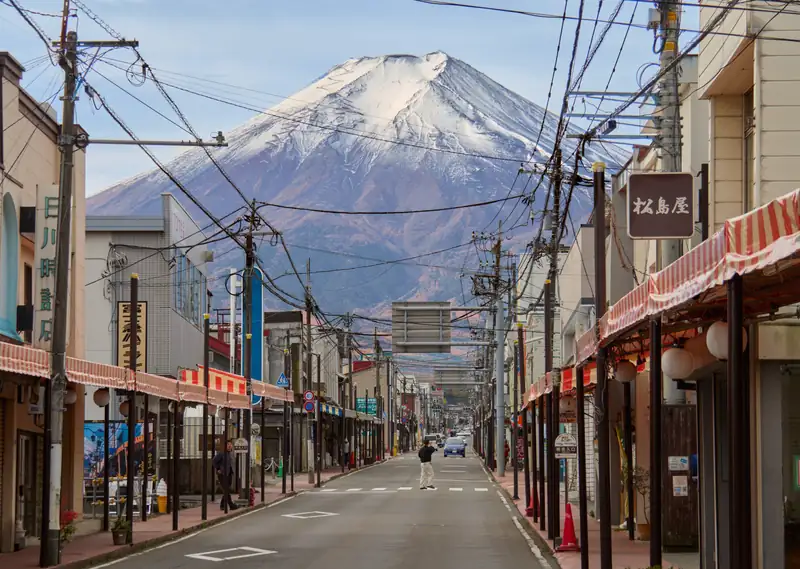
Oshino Hakkai is a group of eight spring-fed ponds in Oshino village, between Lake Yamanaka and Lake Kawaguchiko. There is no gate and no entrance fee, and you can walk round at any hour. The one charge is ¥300 for the Hannoki Bayashi museum, which holds Sokonuke-ike. Arrive early: Tokyo coach tours often stop here over lunch.
Oshino Hakkai is free. There is no ticket office, no gate and no closing time: the eight ponds lie along the lanes of Oshino, a village between Lake Yamanaka and Lake Kawaguchiko, and you walk between them as you would through any village. The one charge is ¥300 for the Hannoki Bayashi Shiryokan, a private museum that holds Sokonuke-ike, the third pond.
The water is the reason to come. It is rain and snow that fell on Mt Fuji and seeped down through layers of lava before welling up here, clear enough that you can see the water plants and the large fish near the bottom of the deeper ponds. The Oshino Village Tourism Association says the filtering takes more than 20 years; japan-guide puts it at over 80.
The ponds were made a national natural monument in 1934 and named among Japan’s 100 best waters in 1985. Since 2013 they have been part of the Fujisan World Heritage site, counted as eight of its 25 components.
Oshino Hakkai entrance fee and opening hours
Checked October 2026.
| Item |
Price |
Hours |
| The eight ponds |
Free |
Open any time; no gate |
| Hannoki Bayashi Shiryokan (with Sokonuke-ike) |
Adult ¥300, child (primary and under) ¥150, infant ¥100 |
9:00 to 17:00; closes on irregular days |
| Car parks around the ponds |
Set by each private lot (Osada lot ¥300 per car) |
Vary by lot |
The tourism association’s own FAQ is blunt about hours: “Oshino Hakkai has no opening hours.” It does ask you not to wander round after dark, because the lanes have few street lights. If the Hannoki museum is shut, you simply miss Sokonuke-ike; the other seven stay visible.
There is no public car park. Every lot near the ponds is privately run and sets its own price, and the association recommends putting the car park’s address into your sat nav, not the tourist office’s, because some systems route you to the village office instead.
What the eight ponds are
The ponds are numbered as stations on an old pilgrimage. Members of the Fuji-ko, the religious groups who climbed Mt Fuji as an act of worship, purified themselves in eight bodies of water before the climb, and these springs were one of the circuits they used. When the practice faded in the late Edo period, a Fuji-ko leader named Tomoemon put up a stone at each pond dedicated to one of the Eight Great Dragon Kings, carved with a poem. Each pond still has its dragon-king stone.
| No. |
Pond |
Notes |
| 1 |
Deguchi-ike |
Sits apart from the other seven; drive there |
| 2 |
Okama-ike |
Down a flight of steps |
| 3 |
Sokonuke-ike |
Inside the Hannoki Bayashi Shiryokan; shallow, 1.5 m |
| 4 |
Choshi-ike |
Narrow, unpaved entrance |
| 5 |
Waku-ike |
Step-free; shops and car parks close by |
| 6 |
Nigori-ike |
Step-free |
| 7 |
Kagami-ike |
Step-free |
| 8 |
Shobu-ike |
Reached by a rough path |
The access notes come from the tourism association’s wheelchair guidance. It lends wheelchairs free from the tourist information centre, but it has only three, so book ahead on 0555-84-4221.
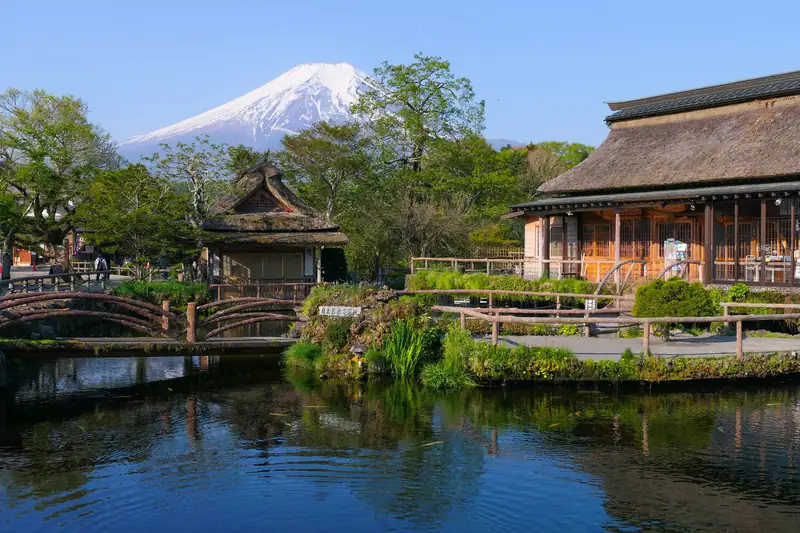
You will also see a round pond in the middle of the village with Fuji behind it. That is Naka-ike, the pond in the photo at the top of this page, and it is not one of the eight.
The village tells its own origin story: the whole valley was once a lake called Utsu-ko, which lava from the eruption of 800 split into Lake Oshino and Lake Yamanaka; Lake Oshino later drained, and the springs are what is left. Geologists have since questioned the single-lake idea, so treat it as the village’s account rather than settled science.
The Hannoki Bayashi Shiryokan
This is the one place you pay. The museum is the Watanabe family farmhouse, built in the late 18th century and, by its own account, the oldest surviving thatched house in Oshino. Inside are the family’s chests and household goods, swords and armour, and upstairs about 300 tools used for farming, weaving and raising silkworms. The prize document is a 1582 letter under the seal of the Hojo clan, written to a Watanabe ancestor after the fall of the Takeda.
Sokonuke-ike is in the garden. The name means “bottomless pond”, and the story the museum tells is that anything dropped in it while washing would vanish and later float up in Okama-ike, the second pond. The museum gives its depth as 1.5 m.
Food at Oshino Hakkai
Several restaurants make a point of using the local spring water. From the tourism association’s listings:
- Ikemoto Chaya, in the middle of the ponds: soba made from Japanese buckwheat ground each day in the water mill, and salt-grilled iwana (char) from a spring-water tank. Open 9:00 to 16:30.
- Hannoki shokudo, the museum’s restaurant: hoto, the thick Yamanashi noodle stew cooked with vegetables. Open 10:30 to about 17:00, or until the food runs out.
- Irori, about five minutes’ walk away: hoto with plenty of vegetables. Closed Tuesdays.
- Inaka, a little further out: hand-made udon using Oshino water. Lunch only, closed Tuesdays.
Several Tokyo coach tours schedule their Oshino stop over lunch, so eat a little before or after the usual hour if you can.
Crowds: when to go
Oshino Hakkai is small, so crowds show quickly. Japan-guide calls it touristy and often crowded. The Oshino tourism association warned in August 2026 that the village centre gets very congested at weekends and over long holidays, and it now advises drivers to park a little further out and walk in rather than queue for a space near the ponds.
Day-trip coaches from Tokyo add to it. Almost every Fuji coach day on our tours page stops here, typically for about an hour and often around lunch. Coaches leaving Tokyo at 7:30 or 8:00 cannot reach the village much before late morning, so an early start from a nearby base beats them. Late afternoon is the other quieter window, though the museum closes at 17:00. Check the visibility guide for the chance of seeing Fuji that day.
The ponds themselves are protected. Don’t put hands, feet or coins in the water, and keep to the paths.
Getting to Oshino Hakkai from Lake Yamanaka
Oshino is the nearest big sight to Lake Yamanaka, about 10 km from the south shore, roughly 14 minutes by car. That makes the lake an easy base: you can be at the ponds before the first coach and back at the lake for breakfast.
| From |
How |
Time |
Notes |
| Lake Yamanaka (Fujisan Yamanakako stop) |
Fujikko-go loop bus |
14 min |
Hourly; first run 8:18 |
| Lake Yamanaka (Asahigaoka) |
Fujikko-go loop bus |
21 min |
Every two hours |
| Lake Yamanaka (Asahigaoka) |
Car |
About 14 min, 10 km |
Free-flow estimate |
| Fujisan Station |
Fujikko-go |
21 min |
Hourly |
| Kawaguchiko Station |
Fujikko-go |
29 min |
Hourly |
| Busta Shinjuku |
Highway bus |
2 h 07 |
Six a day |
Times are from Fujikyu’s timetables, checked October 2026; the drive time is a free-flow estimate, so add time at weekends. The Fujikko-go pass costs ¥1,800 for one day or ¥2,200 for two, and the same bus continues to Hananomiyako Park and round the lake. Buses on the Kawaguchiko to Gotemba line also call at Oshino Hakkai. For the trip from Tokyo, see Tokyo to Lake Yamanaka.
By car from further afield, the tourism association gives five minutes from Yamanakako IC on the Higashi-Fuji Goko Road. In winter it recommends winter tyres: snow falls most years from late November to March, and shaded roads stay icy even when there is none.
Oshino Hakkai on a tour
Most Fuji coach days from Tokyo include Oshino Hakkai, so a tour is the easy option if you are not staying nearby. Several of them also stop at Lake Yamanaka, often first thing for the morning reflection. Check the stop list before you book: some give the lake 20 minutes, others 40 or an hour. All our picks are on the tours page, and the day trip guide compares the main routes.
If you would rather see the ponds without the coach crowd, stay a night at the lake. The Lake Yamanaka hotels guide lists places to stay, and the Fujikko-go gets you to Oshino before the tours do.
Nearby
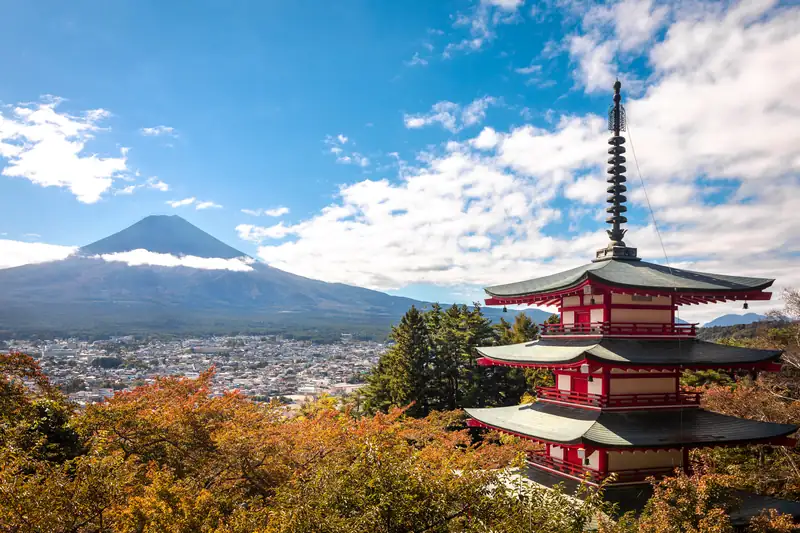
From Oshino, the Chureito Pagoda is about 10 km by road, roughly 15 minutes by car, and Kawaguchiko Station on Lake Kawaguchiko about 11 km. The Fuji Five Lakes guide puts all five lakes in order, and things to do near Mt Fuji covers the rest of the area.