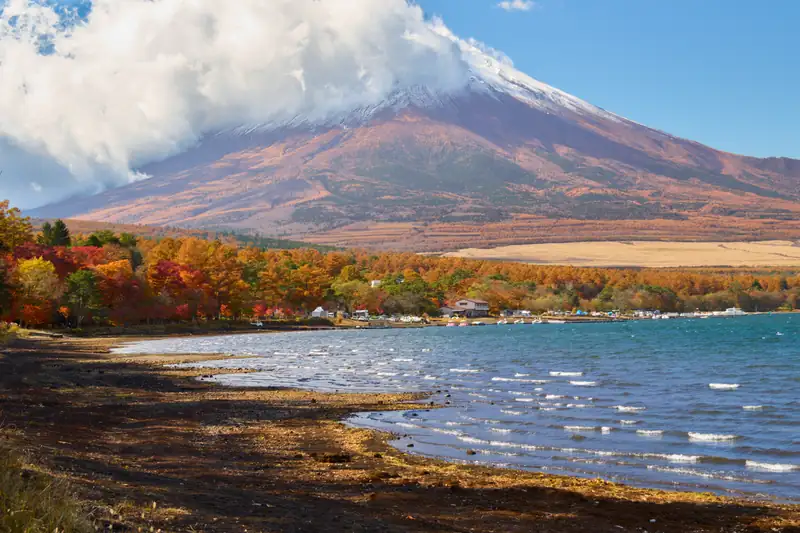
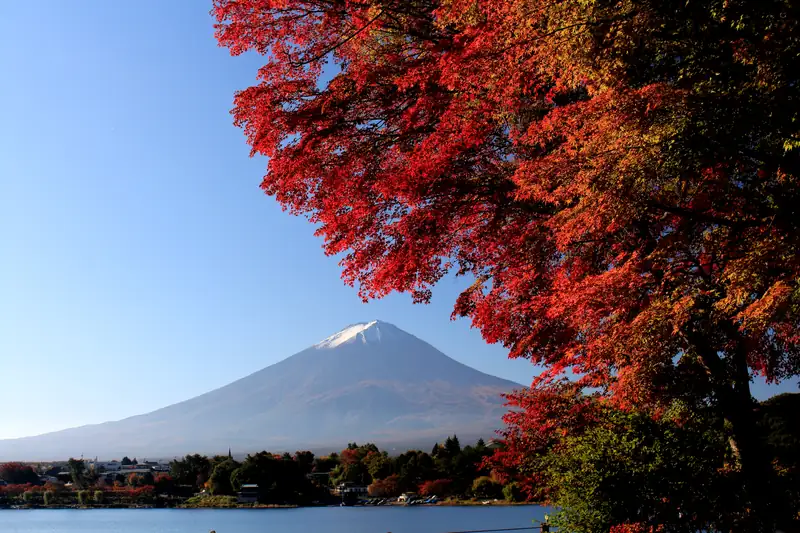
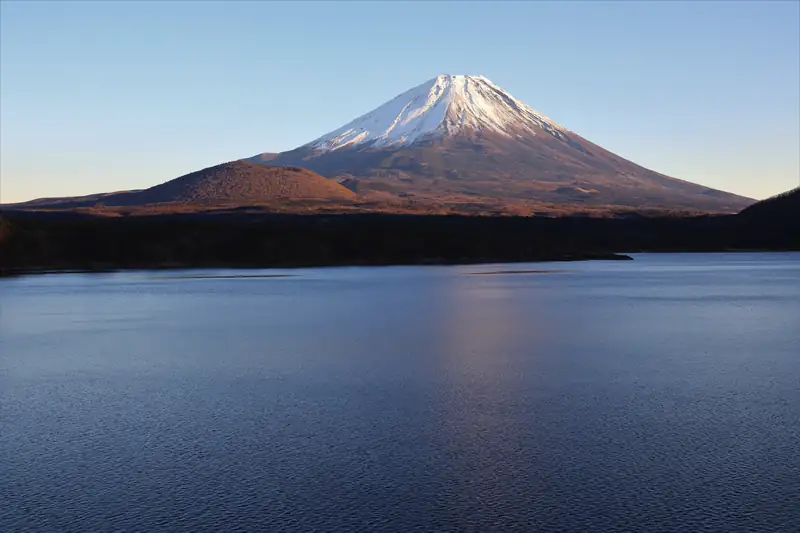
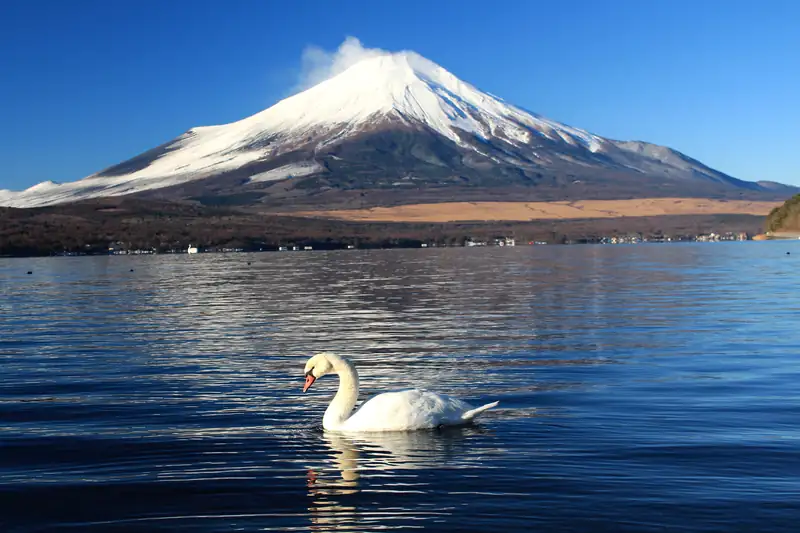
Pick Kawaguchiko for a first visit by public transport: it has the train station, the most hotels and the best-known sights. Pick Lake Yamanaka for a quieter, bigger and higher lake, sunset Diamond Fuji from October to February, cycling and the drive from the Gotemba side. They are about 22 minutes apart by road.
Choose Kawaguchiko if this is your first visit, you are coming by train or bus, or you want the most sights within walking distance of your hotel. Choose Lake Yamanaka if you want a quieter, bigger and higher lake closer to Mt Fuji, sunset Diamond Fuji between October and February, the lakeside cycling path, or a base on the Gotemba and Hakone side. The two lakes are only about 15 km apart, roughly 22 minutes by car, so you do not have to give up either one.
Lake Yamanaka vs Kawaguchiko at a glance
Checked October 2026. Lake figures are Yamanashi Prefecture’s (Geospatial Information Authority data); climate figures are Japan Meteorological Agency averages for 1991 to 2020 at each lake’s weather station.
|
Lake Yamanaka |
Lake Kawaguchiko |
| Area |
6.78 km², largest of the five lakes |
5.70 km², second largest |
| Shoreline |
13.87 km |
20.94 km |
| Surface height |
980.5 m, highest of the five |
830.5 m |
| Deepest point |
13.3 m |
14.6 m |
| Where Fuji is |
To the south-west, across the lake |
To the south, across the lake |
| Best Fuji views |
From the north shore |
From the north shore |
| Development |
Two small towns and a few hotels; north shore less built up |
The most developed lake; the region’s transport hub |
| Train station |
None |
Kawaguchiko Station (Fujikyu line, Fuji Excursion from Shinjuku) |
| Highway bus from Shinjuku |
About 2 h 15 min to Hirano, ¥2,650 (¥2,350 online) |
Just under 2 h, about ¥2,200 |
| Mean temperature, January / August |
-2.4°C / 21.2°C |
-0.4°C / 22.5°C |
| Rain per year |
2,288 mm |
1,586 mm |
| Sunshine per year |
1,884 h |
2,014 h |
| Diamond Fuji |
At sunset, mid-October to late February |
No lakeshore spot on the prefecture’s Diamond Fuji list |
Both lakes are component parts of the Mt Fuji World Heritage site, inscribed in 2013.
Size, height and the view of Mt Fuji
Lake Yamanaka is the biggest of the Fuji Five Lakes by area and the highest, at 980.5 m. Kawaguchiko is smaller in area, but its shoreline is longer: about 21 km against 14 km. Yamanaka is also the shallowest of the five, at 13.3 m, though only just; Kawaguchiko’s deepest point is 14.6 m.
The tourism association calls Yamanaka the closest of the five lakes to Mt Fuji. On a map its west shore is roughly 12 km from the summit, and the tourism association says Fuji looks largest from the Yamanaka district on the west side.
The direction matters more than the distance. Yamanaka sits north-east of the mountain, so from the north shore you look south-west across the water to Fuji, and from mid-October to late February the sun sets onto the summit somewhere along the shore. That is Diamond Fuji, and it is the main reason photographers pick Yamanaka in winter; our Diamond Fuji calendar has the dates for each viewpoint. Kawaguchiko lies north of the summit, so you look south to Fuji, and the classic views are from its north shore around Oishi Park.
Height has a cost. Yamanaka is about 2°C colder than Kawaguchiko in January and gets about 700 mm more rain a year, according to the weather service’s averages. Winter nights at Yamanaka average lows of -8.9°C in January.
Crowds and character
Japan-guide describes Kawaguchiko as the most developed of the five lakes and Yamanaka as the second, with small towns at each end, a few hotels and a less developed north shore. That matches what you see on the ground: Kawaguchiko has the station, the ropeway, the museums and most of the restaurants.
The overtourism stories of recent years came from the Kawaguchiko side. In May 2024 Fujikawaguchiko town put up a black screen to stop crowds photographing Mt Fuji above a convenience store; it came down in August. In 2026 neighbouring Fujiyoshida cancelled its cherry blossom festival at the Chureito Pagoda because of crowding, litter and trespass.
Yamanaka is not empty. In summer, school and university sports clubs fill the lakeside training camps. In the Diamond Fuji season, the tourism association warns that car parks near the viewpoints fill at weekends.
Getting there from Tokyo
Kawaguchiko has a railway. Kawaguchiko Station is the end of the Fujikyu line. The Fuji Excursion limited express runs from Shinjuku in about 2 hours for about ¥4,200 one way, with seat reservations required, according to japan-guide. Highway buses from Shinjuku take just under 2 hours. Our guide to the Fuji Excursion train has the details.
Yamanaka has no station. You arrive by highway bus or car. Checked October 2026, Fujikyu’s Shinjuku buses continue past Kawaguchiko and Fujisan Station to Hirano for ¥2,650, or ¥2,350 booked online; the tourism association gives about 2 hours 14 minutes. Buses from Tokyo Station reach Asahigaoka in about 135 minutes for ¥2,700. By car, the drive from central Tokyo is about 1 hour 45 minutes in free-flowing traffic. Full routes are in Tokyo to Lake Yamanaka.
Getting around. Kawaguchiko has three Omni sightseeing bus lines from the station. Yamanaka has the Fujikko loop bus, which starts at Kawaguchiko Station, runs through Fujisan Station and Oshino Hakkai and then circles the lake; a one-day pass costs ¥1,800. Local buses also link Kawaguchiko Station and Yamanaka once or twice an hour, but they do not reach Hirano at the east end.
What each lake has
Lake Kawaguchiko: Oishi Park and the north-shore Fuji views, the Mt Fuji Panoramic Ropeway, the Kubota Itchiku Art Museum, lake cruises, and most of the area’s hotels and ryokan. The Chureito Pagoda and Fuji-Q Highland are in neighbouring Fujiyoshida, a short train or bus ride away. Our Lake Kawaguchiko guide covers them.
Lake Yamanaka:
- Diamond Fuji at sunset, mid-October to late February.
- The Hananomiyako Koen flower park: tulips in late April, sunflowers in August, cosmos to mid-October.
- The KABA amphibious bus, back since June 2026, and the swan boat from Asahigaoka.
- A cycling road almost all the way round the lake; the tourism association suggests about 1 hour 30 minutes for the loop.
- Panorama-dai, a lookout above the east shore.
- The Mishima Yukio Literary Museum, sailing and other water sports, and wakasagi fishing from heated dome boats in winter.
- Oshino Hakkai, the spring-fed ponds, about 10 km and 15 minutes away.
One gap at Yamanaka this winter: Benifuji no Yu, its Fuji-view hot spring, is closed until a planned March 2027. See our Lake Yamanaka onsen guide for the bath that is open.
Who should pick which
Pick Kawaguchiko if:
- You are visiting without a car, or for one night only.
- You want to walk from your hotel to restaurants, cruises and the ropeway.
- Chureito Pagoda and Fuji-Q Highland are on your list.
Pick Lake Yamanaka if:
- You are driving, cycling, or coming from Gotemba or Hakone; Gotemba is about 30 minutes away by road.
- You want Diamond Fuji at sunset between October and February.
- You prefer a lakeside without a town centre, or you are travelling with children who will like the KABA bus and the flower park.
- You want to be close to Oshino Hakkai.
Still unsure? Base yourself at Kawaguchiko and spend half a day at Yamanaka, or the reverse. Our where to stay near Mt Fuji guide compares the bases, and Lake Yamanaka hotels lists places on this lake. For a wider view of all five lakes, read the Fuji Five Lakes guide; if Hakone is also in the running, see Hakone vs Kawaguchiko.
Seeing both in one day
Many coach tours from Tokyo do exactly this. The most-reviewed one that stops at Lake Yamanaka starts at Hirano Beach for the morning reflection and the swans, then goes to Oshino Hakkai, Oishi Park on Kawaguchiko and the Chureito Pagoda. Tours put Yamanaka first for the morning reflection on the water, which leaves the afternoon for Kawaguchiko. More options are on our Mt Fuji tours page.