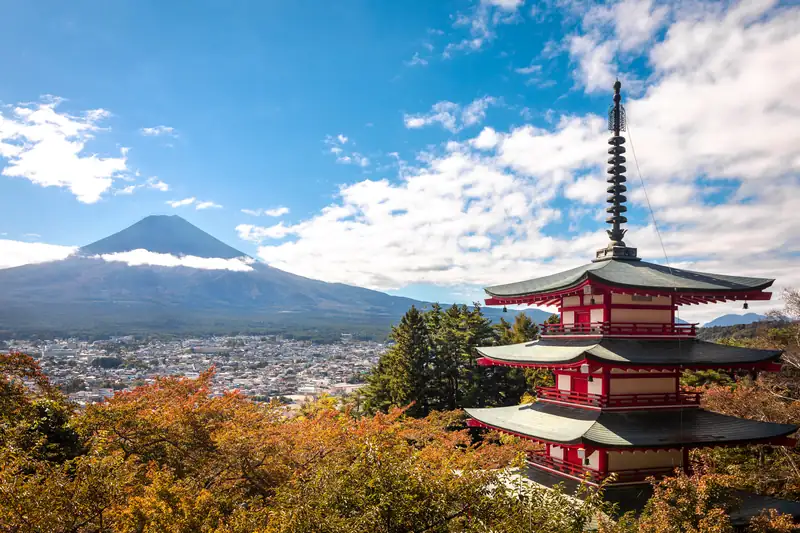
The best things to do near Mt Fuji are around the Fuji Five Lakes: watch Fuji from Lake Yamanaka's north shore, ride the KABA amphibious bus, walk Oshino Hakkai's spring ponds, climb to the Chureito Pagoda, visit Kitaguchi Hongu Fuji Sengen Shrine and Nenba's thatched village, and drive to the 5th Station.
The best things to do near Mt Fuji are around the Fuji Five Lakes, on the mountain’s north side. Watch Fuji from the north shore of Lake Yamanaka, ride the KABA amphibious bus into the lake, walk the spring ponds of Oshino Hakkai, climb to the Chureito Pagoda, and visit Kitaguchi Hongu Fuji Sengen Shrine, where pilgrims started up the mountain.
We start at Lake Yamanaka, which this site covers, and work west. Prices and hours were checked on operators’ sites in October 2026.
Things to do near Mt Fuji at a glance
Checked October 2026.
Things to do at Lake Yamanaka
1. Watch Fuji from the north shore
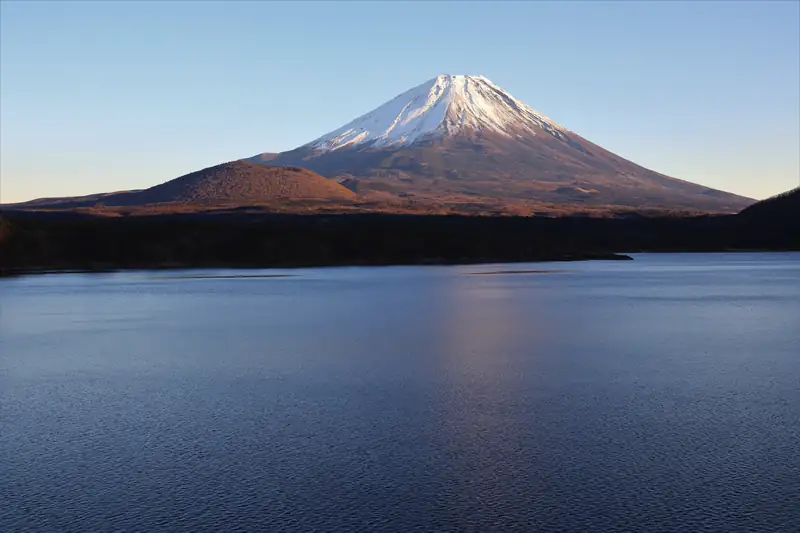
Lake Yamanaka is on the north-east side of Mt Fuji, and its tourism association calls it the closest of the five lakes to the mountain. From Nagaike Shinsui Park and Hirano on the north shore, Fuji stands across open water, often reflected on calm mornings. From mid-October to late February the sun sets onto the summit as seen from points around the lake, an event called Diamond Fuji.
2. Sunrise at Panorama-dai
A roadside lookout on the road from the lake to Mikuni Pass, with Lake Yamanaka below and Fuji to the right. Yamanashi’s tourism site rates it best from December to February before sunrise. The car park has only 7 spaces. Without a car, it’s about 30 minutes on foot from the Mikuniyama hiking course bus stop.
3. Ride the KABA amphibious bus
The KABA drives from the road straight into Lake Yamanaka for a ride of about 30 minutes from the Asahigaoka bus terminal. It was suspended from November 2023 because the lake level dropped, and restarted on 13 June 2026 with new open-roof vehicles. Fares are ¥2,800 for adults (¥3,000 in July and August), booked online through Fujiyama Connect up to 30 days ahead. Details on our KABA bus page.
4. Take the swan boat
The swan-shaped cruise boat “Hakucho no Mizuumi” sails from Asahigaoka pier on a loop of about 20 minutes. An adult ticket is ¥1,200 since 1 April 2026, children 4 to 12 pay ¥600. Some late-afternoon sailings do not run from December to February, and bad weather can cancel it.
5. Walk the flower fields at Hananomiyako
About 300,000 m² of flower fields with Fuji behind them. The outdoor fields are free; the paid zone with the waterfall and greenhouse costs ¥600 for adults from mid-April to mid-October, ¥360 in spring and autumn, and nothing from 1 December to 15 March. Parking is ¥300. See Hananomiyako park.
6. Soak in an onsen
Benifuji no Yu, the village bath with Fuji views, is closed from 28 September 2026 until a planned March 2027. Its sister bath, Ishiwari no Yu in Hirano, is open 11:00 to 19:00 except Thursdays, at ¥900 for adults, with strongly alkaline water (pH 10.2). There is no Fuji view from its baths. Our Benifuji no Yu page has the alternatives, and Mt Fuji ryokan covers hotel baths.
7. Cycle round the lake
A cycling road runs almost all the way round Lake Yamanaka. The tourism association suggests about an hour and a half for the loop, starting and finishing at the Bungaku no Mori park, and part of it follows the Tokyo 2020 Olympic road race route. Yamanakako Cycling Base in Hirano rents bikes, including e-bikes and tandems, but closes in winter.
8. Go wakasagi fishing
Pond smelt were introduced to Lake Yamanaka in 1919, and today most people fish for them from heated dome boats moored on the lake. The prefecture says beginners and children can do it in any season. Prices vary by boat house, so book with one directly.
9. Visit the Mishima Yukio Literary Museum
In the Yamanakako Forest Park of Literature on the south shore, the museum holds the archive of the novelist Mishima Yukio, bought by the village. It is open 10:00 to 16:30, closed Mondays and Tuesdays, and costs ¥700 for adults. The park around it has haiku houses and poem stones.
Things to do near Mt Fuji beyond the lake
10. Oshino Hakkai
Eight spring-fed ponds in Oshino village, about 10 km from Lake Yamanaka, filled with Fuji snowmelt and part of the World Heritage site. Pilgrims used them for purification. The Japan Tourism Agency explains that a Fuji-ko group “revived” the eight springs in the mid-1800s so the eight-lake pilgrimage could be done in a day. Go early, before tour coaches arrive. See Oshino Hakkai.
11. Kitaguchi Hongu Fuji Sengen Shrine
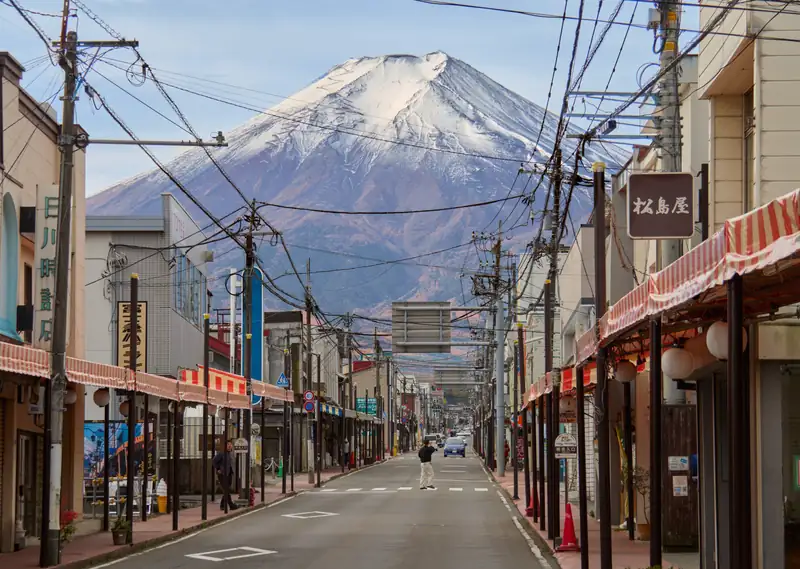
A shrine in Fujiyoshida at the start of the Yoshida Trail, the route pilgrims from Edo took up the mountain. Legend dates its origin to 110 CE; the shrine was built on its present site in 788. The oldest of its three main halls was built in 1223, and its wooden torii, almost 18 m tall, is one of the largest in Japan. On 26 and 27 August the Yoshida Fire Festival, held with Suwa Shrine, closes the climbing season.
12. Chureito Pagoda
A red five-storey pagoda with Fuji behind, reached by 398 steps in Arakurayama Sengen Park, about 10 minutes’ walk from Shimoyoshida Station. Mornings are best. Fujiyoshida cancelled its 2026 cherry blossom festival here because of crowding; the park stays open. See Chureito Pagoda.
13. Fuji-Q Highland
Fujikyu’s amusement park at the foot of the mountain, with coasters including Fujiyama, which the park calls the “King of Coasters”, and Takabisha, which it labels the “Steepest Roller Coaster”. Fujikyu highway buses from Tokyo and the Fujikko loop bus both stop at the park. See Fuji-Q Highland.
14. Oishi Park and the Panoramic Ropeway
On Lake Kawaguchiko’s north shore, Oishi Park has a 350 m flower path along the water, with lavender for the herb festival from late June to mid-July. On the east shore, the Mt Fuji Panoramic Ropeway climbs Mt Tenjo for a view over the lake to Fuji; an adult return is ¥1,200 from 1 November 2026. See Lake Kawaguchiko.
15. Saiko Iyashi no Sato Nenba
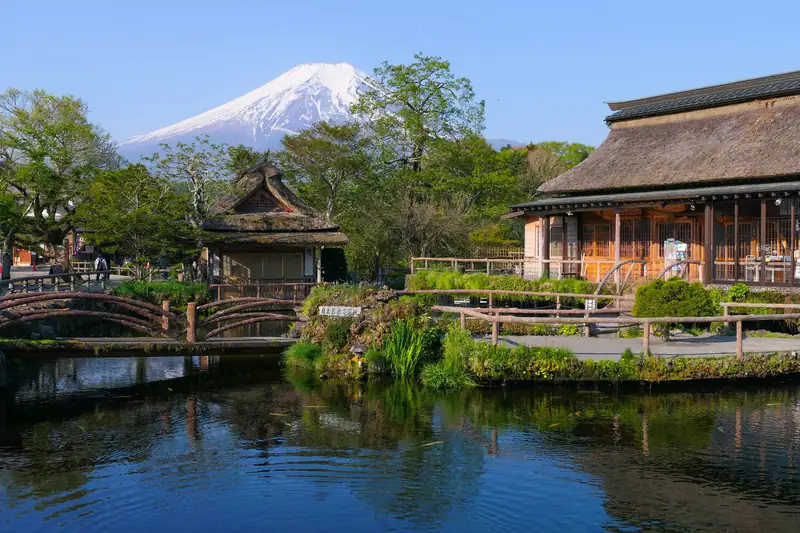
The old hamlet of Nenba on Lake Saiko’s north-west shore was destroyed by a typhoon and debris flow in 1966. About 20 thatched buildings were rebuilt on the site and opened in 2006, with craft workshops, shops and a small museum about the disaster. It faces Fuji to the south. Take the Saiko sightseeing bus from Kawaguchiko Station. We found no official price list, so check at the gate.
16. Narusawa Ice Cave and Fugaku Wind Cave
Two lava caves in the forest near Lake Saiko. The Narusawa Ice Cave drops about 21 m down a steep shaft, and its deepest part stays below freezing all year; the loop takes 10 to 15 minutes and the steps are slippery. The Fugaku Wind Cave is gentler, a 201 m passage at about 3 °C. Both were once used as natural fridges. See Narusawa Ice Cave.
17. Drive the Subaru Line to the 5th Station
The Fuji Subaru Line climbs from the lakes to the Yoshida Trail’s 5th Station. Winter can cut it short: after 18 January 2026 it ran only to the 1st or 4th Station car parks, and the full road reopened on 18 April. From 3 July to 10 September 2026 private cars were banned, and visitors took shuttle buses from Fuji-san Parking. See Mt Fuji 5th Station.
18. Climb Mt Fuji
Only in season: 1 July to 10 September in 2026. On the Yoshida Trail you book ahead, pay ¥4,000 per climb, and a daily cap of 4,000 climbers applies. The official climbing site advises staying in a mountain hut and watching sunrise from the trail rather than climbing overnight.
19. Fuji Shibazakura Festival
Each spring, about 500,000 moss phlox plants bloom in front of Fuji at Fuji Motosuko Resort near Lake Motosu. The 2026 festival ran from 11 April to 24 May, with a direct bus from Kawaguchiko Station of about 40 minutes. See Fuji Shibazakura Festival.
Plan your days
Most of this list fits into two days. Put Lake Yamanaka, Oshino Hakkai and Fujiyoshida on one, and Lake Kawaguchiko, Saiko and the caves on the other, and do the Fuji viewpoints first thing in the morning, when the mountain is most often clear. Our Fuji Five Lakes guide compares the lakes, Mt Fuji visibility links the live cameras, and where to stay near Mt Fuji helps you pick a base. Short on time? A day trip from Tokyo or one of our tours covers several of these in a day.