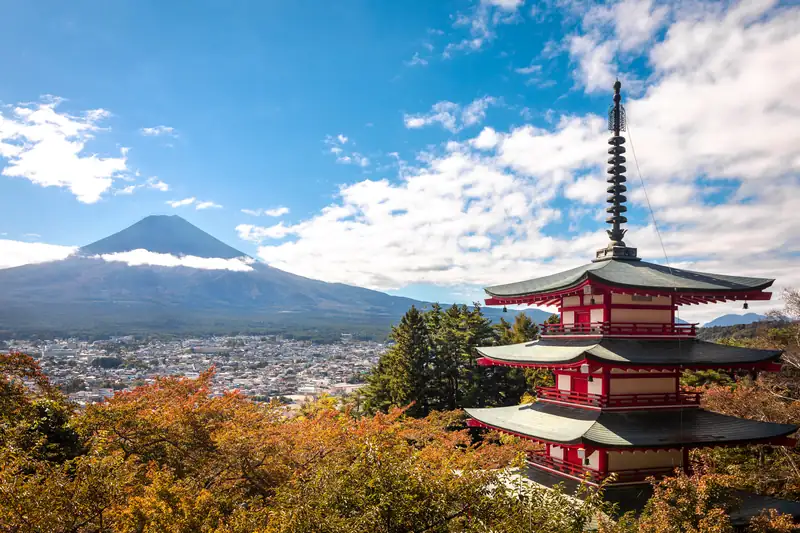
The best place to see Mt Fuji is the north shore of Lake Yamanaka, where the mountain rises straight across the water, with Panorama-dai above it a close second. Chureito Pagoda, Oishi Park on Lake Kawaguchiko and Lake Motosu's ¥1,000-note view follow. Go early: mornings are clearest, except for winter sunsets at Yamanaka.
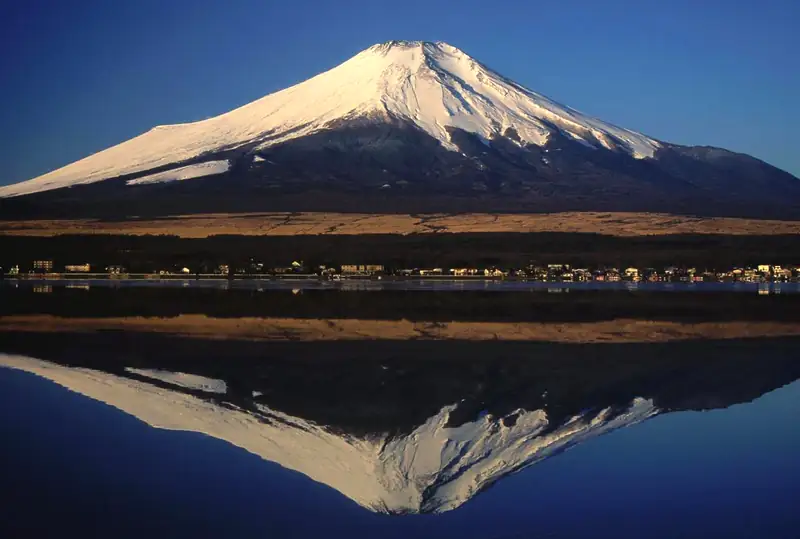
The best place to see Mt Fuji is the north shore of Lake Yamanaka. From Nagaike Shinsui Park or Hirano beach, the whole mountain rises across open water, often doubled in the lake on still mornings. Panorama-dai, a roadside lookout above the same shore, is the best sunrise spot in the area.
We ranked eleven viewpoints around the Fuji Five Lakes on the view itself, how easy they are to reach and how crowded they get. All of them are on the north side of the mountain, where the lakes are. Whichever you pick, go early. Fuji City’s 35-year record shows the whole mountain at 8am on 37 percent of days and at 4pm on 23 percent.
Mt Fuji viewpoints at a glance
Side of Fuji is worked out from each spot’s position on the map. Access and car park figures are from Yamanashi Prefecture’s viewpoint pages.
Checked October 2026.
| Rank |
Viewpoint |
Side of Fuji |
Getting there |
Best time |
| 1 |
Lake Yamanaka north shore (Nagaike, Hirano) |
North-east |
5 min from Yamanakako IC; Fujikko bus about 40 min from Fujisan Station; 80 car spaces at Nagaike |
Dawn; winter sunsets |
| 2 |
Panorama-dai |
North-east, above Lake Yamanaka |
20 min drive from Yamanakako IC; 7 car spaces; or 30 min walk from a Fujikko bus stop |
Before sunrise, Dec to Feb |
| 3 |
Chureito Pagoda |
North |
10 min walk from Shimoyoshida Station, then 398 steps |
Morning |
| 4 |
Oishi Park, Lake Kawaguchiko |
North |
Retro bus about 30 min from Kawaguchiko Station; 40 car spaces |
Morning; lavender late June to mid-July |
| 5 |
Mt Fuji Panoramic Ropeway, Mt Tenjo |
North |
Ropeway from Lake Kawaguchiko’s east shore |
Morning |
| 6 |
Lake Motosu, Nakanokura Pass |
North-west |
50 min drive from Kawaguchiko IC; 30 min walk from the car park |
Morning |
| 7 |
Lake Shoji (Kodaki Fuji) |
North-west |
Bus about 40 min from Kawaguchiko Station |
Evening |
| 8 |
FUJIYAMA Twin Terrace, Shindo Pass |
North, high above the lakes |
Shuttle bus only for the last stretch; April to late November |
Clear mornings |
| 9 |
Saiko Iyashi no Sato Nenba |
North-west |
Saiko sightseeing bus from Kawaguchiko Station |
Morning |
| 10 |
Oshino Hakkai |
North-east |
About 10 km from Lake Yamanaka; Fujikko bus |
Early, before tour groups |
| 11 |
Fujiyoshida Honcho-dori |
North |
Walk from Shimoyoshida or Fujisan Station |
Morning |
1. Lake Yamanaka north shore
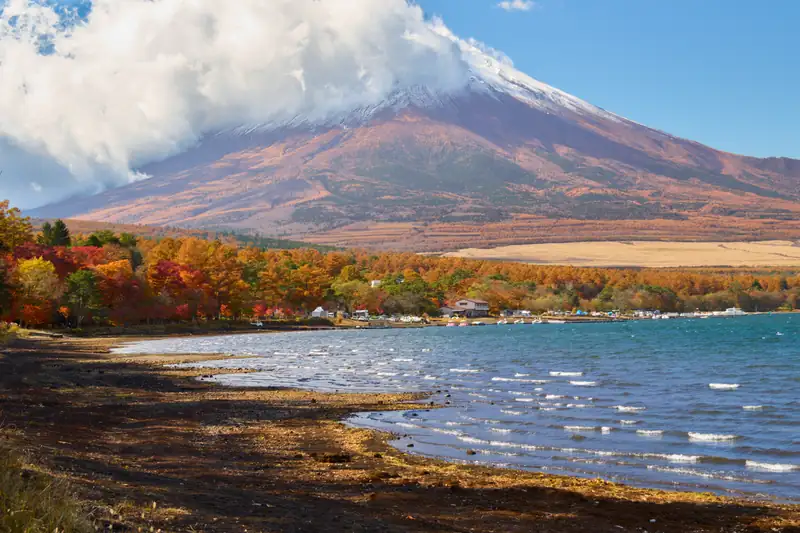
This is the view we would pick if we could only see Fuji once. Lake Yamanaka sits on the north-east side of the mountain, and the tourism association calls it the closest of the Fuji Five Lakes to Fuji. From the north shore you look south-west across the water with nothing between you and the mountain.
Nagaike Shinsui Park is the easy stop: 80 parking spaces, a toilet across the road, and a Fujikko bus stop named after it. The prefecture’s page notes the view draws many photographers at sunset. On calm mornings you get the upside-down Fuji in the lake. In early February (about 1 to 7 February) the sun sets onto the summit here, and in mid-November or early February you may see a double Diamond Fuji, sun and reflection together.
Hirano, at the east end, is where many Tokyo day tours stop; several on our tours page start their day at Hirano Beach for the morning reflection and the swans.
2. Panorama-dai
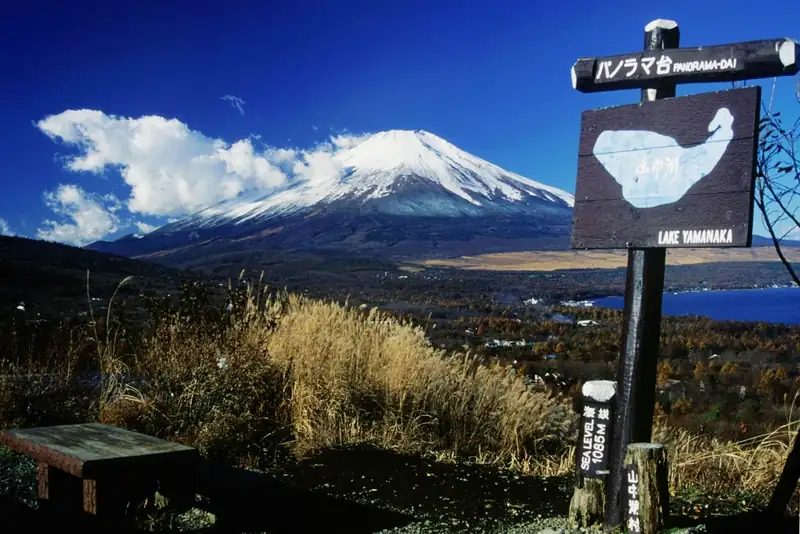
Panorama-dai (Myojinyama Panorama-dai) is a lookout on the road from Lake Yamanaka up to Mikuni Pass. The lake fills the foreground, Fuji stands to the right, and on clear days the Southern Alps show on the horizon. Yamanashi’s tourism site rates it best from December to February before sunrise, when a pink band (the “Venus belt”) and the blue shadow of the earth sit above the horizon. At sunset the scene turns red.
It’s small. The car park has 7 spaces plus 1 wheelchair space, and it fills fast in winter. Without a car, take the Fujikko bus to the Mikuniyama hiking course entrance and walk about 30 minutes. The Yamanakako Tourist Association runs a live camera here, so you can check the view before you go (links on our Mt Fuji visibility page).
3. Chureito Pagoda
The postcard view: a red five-storey pagoda with Fuji behind it, from Arakurayama Sengen Park in Fujiyoshida. You climb 398 steps from the shrine to the observation deck, which reopened after renovation in February 2022. The prefecture recommends mornings, when the sun is behind you and lights the mountain, and puts the autumn colour at late October to mid-November.
Expect crowds. Fujiyoshida cancelled its 2026 cherry blossom festival here because of crowding, litter and trespass, though the park stayed open. See our Chureito Pagoda guide for timing.
4. Oishi Park, Lake Kawaguchiko
On the north shore of Lake Kawaguchiko, a 350 m flower path runs along the water with Fuji across the lake. The prefecture counts over 90 kinds of flowers, lavender for the herb festival from late June to mid-July and red kochia bushes in autumn. It has 40 car spaces and a retro bus from Kawaguchiko Station (about 30 minutes).
5. Mt Fuji Panoramic Ropeway
The ropeway climbs Mt Tenjo from the east shore of Lake Kawaguchiko to a deck looking over the lake to Fuji. From 1 November 2026 an adult return costs ¥1,200, according to the operator. It closes for maintenance from 7 to 18 December 2026. The deck has its own 4K live camera.
6. Lake Motosu and the ¥1,000-note view
The westernmost lake. Photographer Okada Koyo took his picture of Fuji reflected in Lake Motosu in 1935, and it was used on the back of the old ¥5,000 and ¥1,000 notes. The viewpoint is at Nakanokura Pass, about 30 minutes’ walk from the 30-space car park by the lakeshore road. Motosu is also on the west side for sunrise: the Japan Tourism Agency describes the sun rising over the summit here around New Year’s Day, at about 7:40.
7. Lake Shoji and Kodaki Fuji
From the north shore of Lake Shoji, the smallest of the five lakes, Fuji appears to hold the smaller Mt Omuro in front of it, a view called Kodaki Fuji, “Fuji holding a child”. The Japan Tourism Agency says photographers come in the evening for red Fuji, and for pink Fuji when there is snow on the peak. The lake can freeze from mid-January.
8. FUJIYAMA Twin Terrace, Shindo Pass
Two decks on Shindo Pass in Fuefuki, north of the lakes. The second faces Fuji head-on; the first adds Lakes Kawaguchiko and Yamanaka below. Private cars cannot drive the last stretch, so you park at Lily Bell Hütte and take a paid shuttle, which ran from late April to late November in 2025. Check the 2026-27 timetable before you go.
9. Saiko Iyashi no Sato Nenba
A village of restored thatched houses on the north-west shore of Lake Saiko, rebuilt after a 1966 typhoon destroyed the original hamlet. It faces Fuji to the south. More in things to do near Mt Fuji.
10. Oshino Hakkai
Spring-fed ponds and thatched roofs with Fuji behind, about 10 km from Lake Yamanaka. Go early: the village gets busy once the day tours arrive. See our Oshino Hakkai guide.
11. Fujiyoshida Honcho-dori
A shopping street that ends in Mt Fuji. It’s become a problem spot: crowds stopping on the crossing at Honcho 2-chome have blocked traffic, and the city has put up signs and posted guards. Take your photo from the pavement and move on.
Mt Fuji sunrise: where to go
- Panorama-dai, December to February, before dawn. The easiest by car.
- Lake Yamanaka north shore, for soft first light on the mountain and reflections.
- Lake Motosu, for the sun rising over the summit around New Year.
- On the mountain, in climbing season (1 July to 10 September in 2026). The official climbing site says sunrise can be seen from anywhere on the Yoshida Trail above the 5th Station, and advises watching it from a mountain hut rather than climbing through the night.
Mt Fuji sunset: where to go
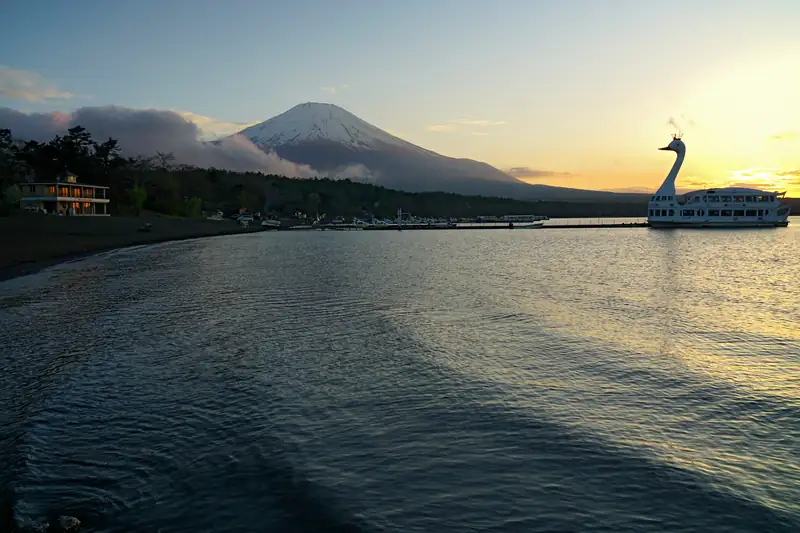
From mid-October to late February, Lake Yamanaka is the place. The point on the shore where the sun sets onto the summit moves as the season goes on, starting at Panorama-dai and Asahigaoka in mid to late October. Our Diamond Fuji page has the spot-by-spot calendar. Lake Shoji is the other sunset favourite.
Make the most of it
Staying overnight is the single biggest help, because it puts you at a viewpoint at dawn. Our Lake Yamanaka hotels guide lists places near the north and south shores, and Mt Fuji view hotels covers rooms that face the mountain. For the odds by month, see the best time to see Mt Fuji.