The Fuji Five Lakes are Yamanaka, Kawaguchiko, Saiko, Shoji and Motosu, strung in an arc along the north side of Mt Fuji in Yamanashi. Yamanaka is the largest and highest, Kawaguchiko the busiest, Motosu the deepest, Shoji the smallest. Base yourself at Yamanaka or Kawaguchiko; local buses link all five.
The Fuji Five Lakes (Fuji Goko) are five lakes in an arc along the northern foot of Mt Fuji, in Yamanashi Prefecture. From east to west they are Lake Yamanaka, Lake Kawaguchiko, Lake Saiko, Lake Shoji and Lake Motosu. The name is younger than you might think: the Japan Tourism Agency says it was coined in 1927 for a newspaper contest to pick Japan’s finest scenery.
Lake Yamanaka is the largest and highest of the five and, according to its tourism association, the closest to Fuji. Kawaguchiko is the hub, with the station, most hotels and the busiest sights. The three western lakes are smaller, deeper and quieter.
The Fuji Five Lakes compared
Area, depth, elevation and circumference are from Yamanashi Prefecture’s lake table, using Geospatial Information Authority of Japan data.
Checked October 2026.
| Lake |
Area |
Circumference |
Depth |
Elevation |
Known for |
Our guide |
| Yamanaka |
6.78 km² |
13.87 km |
13.3 m |
980.5 m |
Largest, highest, closest to Fuji; Diamond Fuji sunsets; swans and the KABA bus |
Lake Yamanaka |
| Kawaguchi |
5.70 km² |
20.94 km |
14.6 m |
830.5 m |
Transport hub; Oishi Park; ropeway; only island in the five |
Lake Kawaguchiko |
| Sai |
2.12 km² |
9.85 km |
71.7 m |
900.0 m |
Nenba thatched village; lava caves; walking |
Things to do near Mt Fuji |
| Shoji |
0.51 km² |
6.80 km |
15.2 m |
900.0 m |
Smallest; Kodaki Fuji view; quiet |
This page |
| Motosu |
4.70 km² |
11.82 km |
121.6 m |
900.0 m |
Deepest; the ¥1,000-note view; Shibazakura festival nearby |
This page |
The Japan Tourism Agency gives Lake Motosu’s depth as 138 m; we use the prefecture’s 121.6 m. Lakes Motosu, Shoji and Sai share the same 900 m surface level, and the agency notes geologists think they are connected underground.
Lake Yamanaka
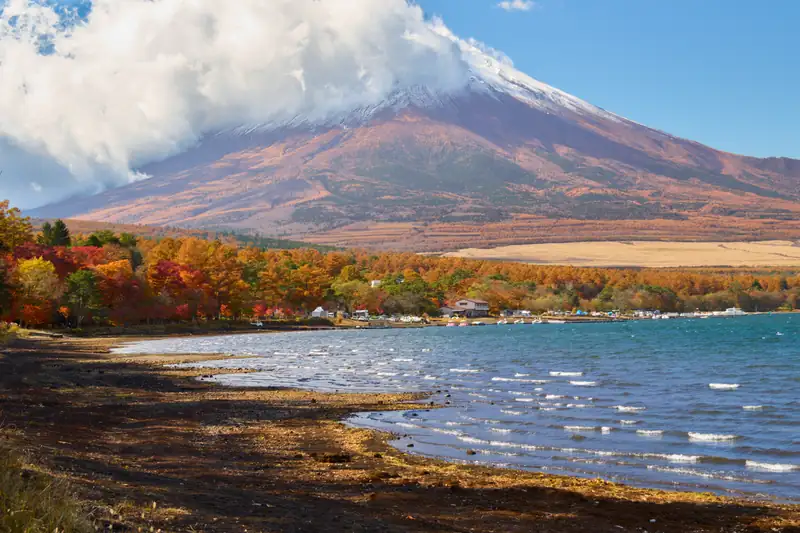
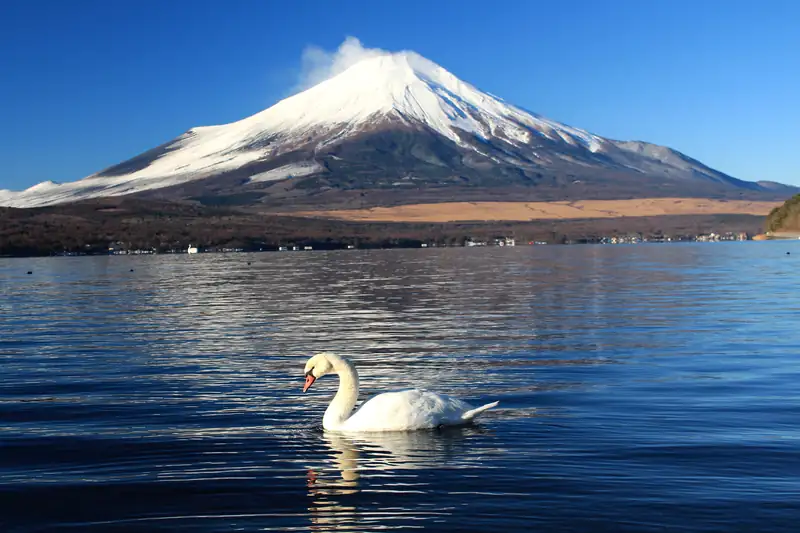
Lake Yamanaka is the one this site is about, so we are biased, but the numbers back it up. It’s the largest of the five by area and the highest, at 980.5 m. It lies on the north-east side of the mountain, so from the north shore at Nagaike and Hirano you look straight across the water at Fuji, and from mid-October to late February the sun sets onto the summit as seen from points around the shore, the event called Diamond Fuji.
It is also the most relaxed of the big two. You can ride the KABA amphibious bus from the land into the lake, take the swan-shaped cruise boat from Asahigaoka, walk or cycle the lakeside path and see the flower fields at Hananomiyako park. The village onsen Benifuji no Yu is closed until a planned March 2027, but Ishiwari no Yu in Hirano is open. Summer brings sailing, windsurfing and student sports camps; winter brings wakasagi fishing from heated dome boats.
Lake Yamanaka is the source of the Katsura River, and it is a World Heritage component part in its own right. For where to sleep, see Lake Yamanaka hotels; for the trip from the city, Tokyo to Lake Yamanaka.
Lake Kawaguchiko
The second-largest lake and the lowest, at 830.5 m, with the longest shoreline (20.94 km). It has the only island in the five, Unoshima. Kawaguchiko Station, on the Fujikyu line from Otsuki, is where most local buses start, and the town has the widest choice of hotels and restaurants.
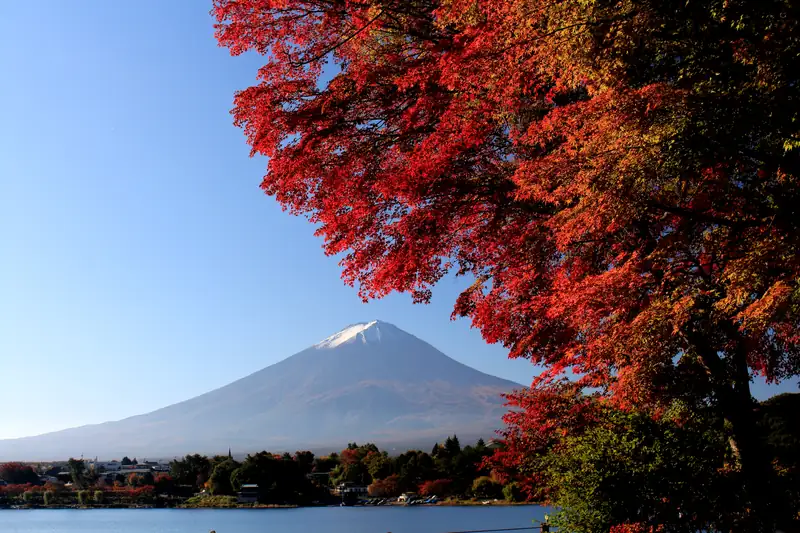
The north shore holds Oishi Park, where a 350 m flower path runs beside the water with Fuji across the lake, and the Momiji Corridor, the focus of the autumn leaves festival (7 to 29 November in 2026). On the east shore, the Mt Fuji Panoramic Ropeway climbs Mt Tenjo for a view over the lake. The cherry blossom festival on the north shore ran into mid-April in 2026. Our Lake Kawaguchiko guide covers it in full, and Lake Yamanaka vs Kawaguchiko helps you choose a base.
Lake Saiko
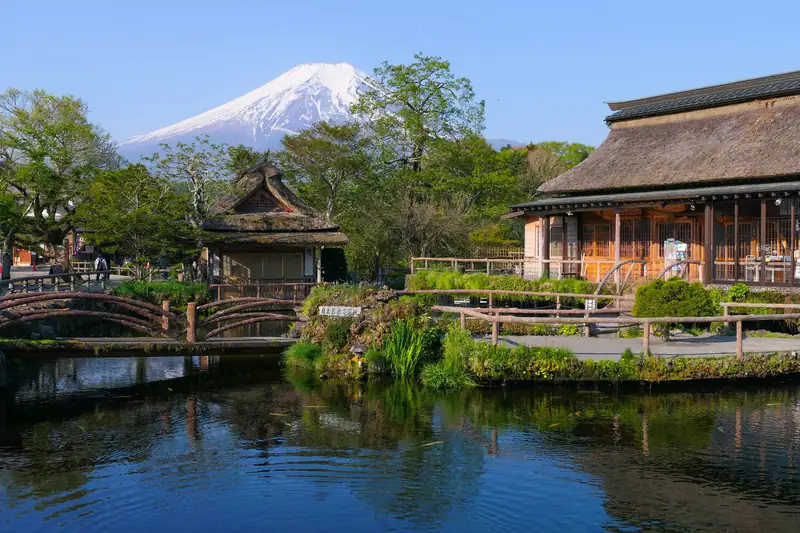
Lake Saiko is deep (71.7 m), with mountains close behind its north shore, which is why the Japan Tourism Agency singles it out for hiking. On the north-west shore, Saiko Iyashi no Sato Nenba is a village of restored thatched houses facing Fuji. The original hamlet was destroyed by a typhoon in 1966; the rebuilt village opened in 2006 with craft workshops, shops and a small museum about the disaster.
The south shore runs along the edge of the Aokigahara forest, with lava caves nearby: the Fugaku Wind Cave, the Saiko Bat Cave and, a short drive away, the Narusawa Ice Cave. Lake Saiko also made the news in 2010, when Kyoto University researchers confirmed that kunimasu, a fish thought extinct since 1940 in its home, Lake Tazawa, was living here.
Lake Shoji
The smallest of the five, at just 0.51 km². The Japan Tourism Agency credits it with some of the most memorable views in the region, thanks to clear water and little lakeside building. From the north shore, Fuji appears to cradle the smaller cone of Mt Omuro in front of it, a view called Kodaki Fuji (“Fuji holding a child”). The Japan Tourism Agency says photographers come at sunset for red Fuji, and for pink Fuji when the peak has snow.
Shoji was also the first lake to court foreign visitors. In 1895 Harry Stewart Whitworth, a British man who later became a Japanese citizen, opened a European-style hotel here and called the area the “Switzerland of the East”. The lake can freeze from mid-January. It is about 40 minutes by bus from Kawaguchiko Station.
Lake Motosu
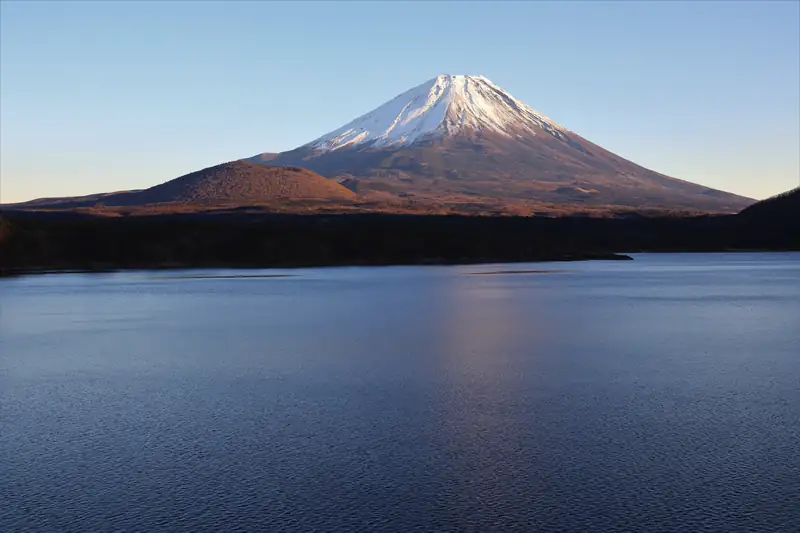
The westernmost and deepest lake (121.6 m by the prefecture’s figure), which the Japan Tourism Agency calls the most remote and popular with campers. Okada Koyo photographed Fuji reflected in Lake Motosu in 1935, and that picture went onto the back of the old ¥5,000 and ¥1,000 notes. The viewpoint is at Nakanokura Pass, about 30 minutes’ walk from the lakeshore car park.
Because Motosu is west of the mountain, it gets sunrise Diamond Fuji, around New Year. Each spring the Fuji Shibazakura Festival fills a field at Fuji Motosuko Resort with about 500,000 moss phlox plants (11 April to 24 May in 2026); see our Fuji Shibazakura Festival guide.
All five were made by Mt Fuji’s lava blocking valleys. According to the Japan Tourism Agency, the three western lakes were once one large lake, the Old Senoumi. Motosu was cut off by lava about 4,500 years ago, and the Jogan eruption of 864 split the rest into Shoji and Sai. Later eruptions dammed the rivers to the north-east that became Kawaguchiko and Yamanaka. Exactly which eruption formed Lake Yamanaka is still debated.
Fuji Five Lakes map: how they fit together
Picture an arc around the north side of Fuji. Lake Yamanaka is at the east end, near the Yamanakako interchange on the road from Gotemba and the Tomei Expressway. Oshino Hakkai and Fujiyoshida (with Fujisan Station, Fuji-Q Highland and the Chureito Pagoda) sit between Yamanaka and Kawaguchiko. Kawaguchiko is in the middle, with the Kawaguchiko interchange on the Chuo Expressway from Tokyo. Saiko, Shoji and Motosu run west from there, with the Aokigahara forest on the lower slopes between Saiko and the mountain.
Getting around the five lakes
Checked October 2026.
| Route |
Between |
Notes |
| Fujikko loop bus |
Kawaguchiko Station, Fuji-Q Highland, Fujisan Station, Oshino Hakkai, Hananomiyako, round Lake Yamanaka to Hirano |
11 runs a day; Suica and PASMO accepted |
| Fujikyu bus towards Gotemba |
Kawaguchiko Station to Asahigaoka (Lake Yamanaka) |
About 38 minutes |
| Fujiyoshida, Oshino and Yamanaka area pass |
Unlimited local rides in the eastern area |
¥1,800 for 1 day, ¥2,200 for 2 days (adult); not valid from Asahigaoka towards Gotemba |
| Saiko sightseeing bus |
Kawaguchiko Station to Saiko and Nenba |
About 40 minutes to Nenba |
| Bus to Lake Shoji |
Kawaguchiko Station to Lake Shoji |
About 40 minutes |
| Car |
All five |
Kawaguchiko to Lake Yamanaka about 15 km; Kawaguchiko IC to Lake Motosu about 50 minutes |
Bus times are indicative; Fujikyu revises timetables during the year. For getting here from the city, see Tokyo to Mt Fuji.
Where to stay
Most visitors stay at Kawaguchiko for its station and choice of hotels, or at Lake Yamanaka for a quieter base on the water. Our where to stay near Mt Fuji guide compares the areas, and Mt Fuji ryokan and Mt Fuji view hotels narrow it down.
More around the lakes