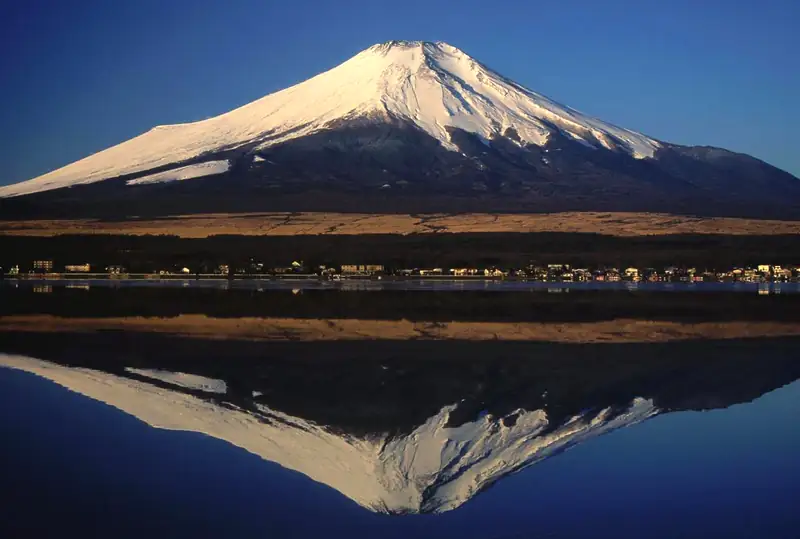
Snow-capped Mount Fuji under a deep blue sky, rising above the far shore of Lake Yamanaka with dark rippled water in the foreground

Lake Yamanaka (Yamanakako)

The largest of the Fuji Five Lakes, at the foot of Mt Fuji.

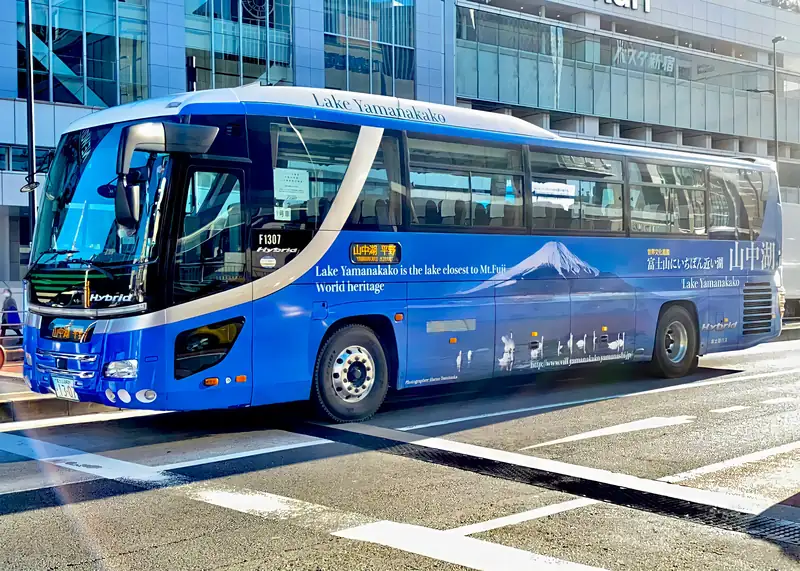
Lake Yamanaka (Yamanakako) is the largest and highest of the Fuji Five Lakes, at 980.5 m on the northeastern foot of Mt Fuji in Yamanashi, Japan. People come for the Fuji views, the swans, the lakeside cycle path and, from mid-October to February, the sun setting on the summit. Buses from Shinjuku take about 2 to 2.5 hours.

Lake Yamanaka quick facts

  • 980.5 m

    Elevation

    The highest of the Fuji Five Lakes.

  • 6.78 km²

    Area

    The largest of the five by area.

  • 13.87 km

    Circumference

    Other sources round the shoreline to 13 or 14 km.

  • 13.3 m

    Maximum depth

    The shallowest of the five, just: Kawaguchiko reaches 14.6 m.

Where
Yamanakako Village, Minamitsuru District, Yamanashi Prefecture, at the northeastern foot of Mt Fuji. It is the easternmost of the Fuji Five Lakes.
Distance to Mt Fuji
About 12 to 13 km in a straight line from the south and west shores to the summit, measured on a map. The local tourism association calls it the closest lake to Mt Fuji.
From Tokyo
About 2 to 2.5 hours by highway bus from Shinjuku. By car about 1.5 hours from central Tokyo in light traffic, according to the local tourism association, and longer at weekends.
From Kawaguchiko
About 30 to 40 minutes by local bus from Kawaguchiko Station, 15 km by road.
Clearest Fuji views
Late autumn and winter. In summer and early autumn the mountain is often in cloud.
World Heritage
One of the 25 component parts of “Fujisan, sacred place and source of artistic inspiration”, inscribed in June 2013.

Lake figures: Yamanashi Prefecture, from Geospatial Information Authority of Japan data.

A lake made by Mt Fuji

Lava from Mt Fuji blocked a valley and the water backed up behind it to form the lake. Geologists still debate which eruption did it. Groundwater from the mountain wells up through the lakebed, and the lake is the source of the Katsura River.

Pilgrims came long before tourists. Members of the Fuji-ko pilgrim movement purified themselves in a circuit of eight lakes, the “inner eight lakes”. Yamanashi Prefecture says a late 16th-century document attributed to Hasegawa Kakugyo, the movement’s founding figure, already names Yamanaka.

The prefecture gives that pilgrimage, and the upside-down Fuji mirrored in the lakes, as reasons the Fuji Five Lakes are part of the World Heritage site.

  1. 1733A text by the Fuji pilgrim leader Jikigyo Miroku lists eight lakes for the “inner eight lakes” (Uchi-hakkai) purification circuit, Yamanaka among them.
  2. 1925The first holiday villas go up on the southeast shore, the start of tourism at the lake.
  3. 1936Fuji-Hakone National Park, which takes in the lake, is designated on 1 February.
  4. 2013Lake Yamanaka becomes one of the component parts of the Fujisan World Heritage site.
Mount Fuji and its mirror image in the calm surface of Lake Yamanaka in winter light
The upside-down Fuji on a calm winter morning.

What you see at Lake Yamanaka

Fuji across the water first, then the swans, the boats and the shore. The swan boat and the KABA bus both leave from Asahigaoka on the south shore.

The setting sun sitting on the summit of the dark silhouette of Mount Fuji, its light reflected on Lake Yamanaka

Fuji views and Diamond Fuji

The north shore looks straight across the water at Fuji. From mid-October to late February the sun sets exactly onto the summit, seen from a different spot every few days: Panorama-dai and the Asahigaoka shore in mid to late October and again in February, Hananomiyako Koen in mid to late December (the prefecture’s guide dates).

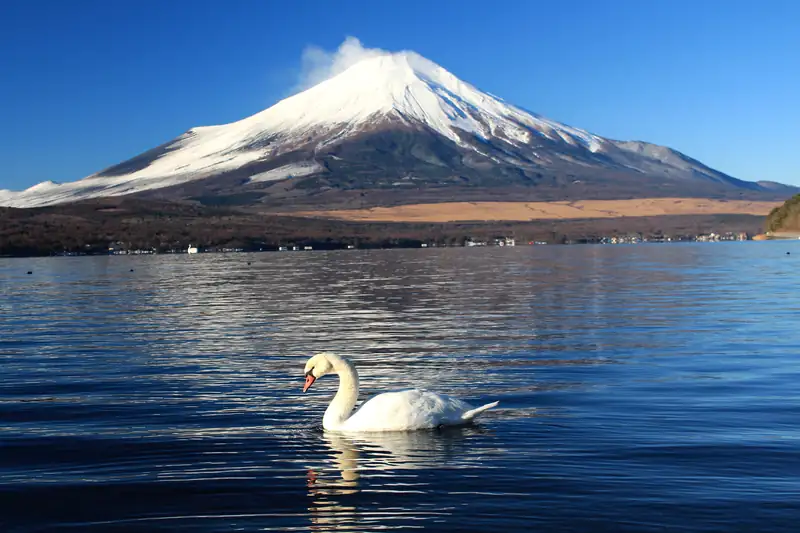
A single white swan swimming on blue Lake Yamanaka, with snow-capped Mount Fuji on the far shore

Swans and the swan boat

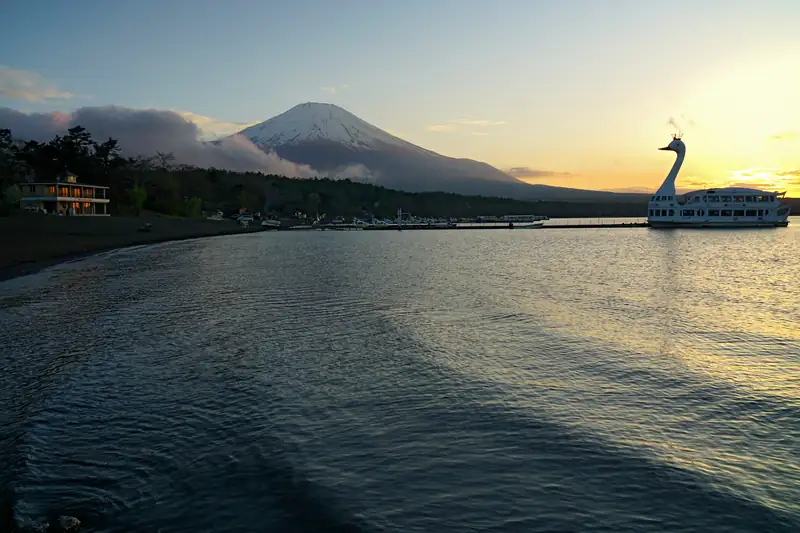
Mute swans live on the lake all year, and the swan is the village bird. The swan-shaped cruise boat Hakucho no Mizuumi (“Swan Lake”) does a lap of about 20 minutes from Asahigaoka pier: ¥1,200 for adults and ¥600 for children aged 4 to 12 (checked October 2026).

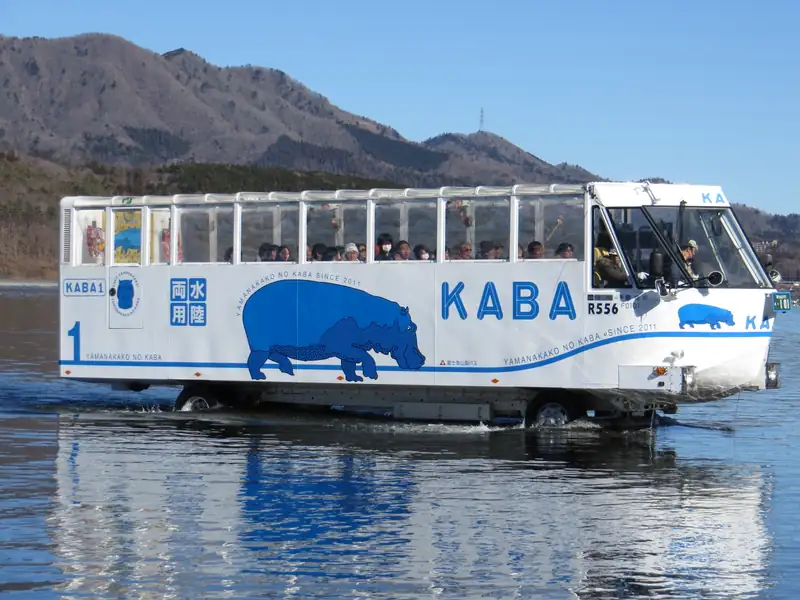
The white KABA amphibious bus with its blue hippo logo driving out of the water of Lake Yamanaka

The KABA amphibious bus

A bus that drives off the road and into the lake, on a ride of about 30 minutes from the Mori-no-Eki Asahigaoka terminal. It has run again since 13 June 2026, after low water stopped it in November 2023. Adults ¥2,800, children ¥1,400, a little more in July and August; book online up to 30 days ahead (checked October 2026).

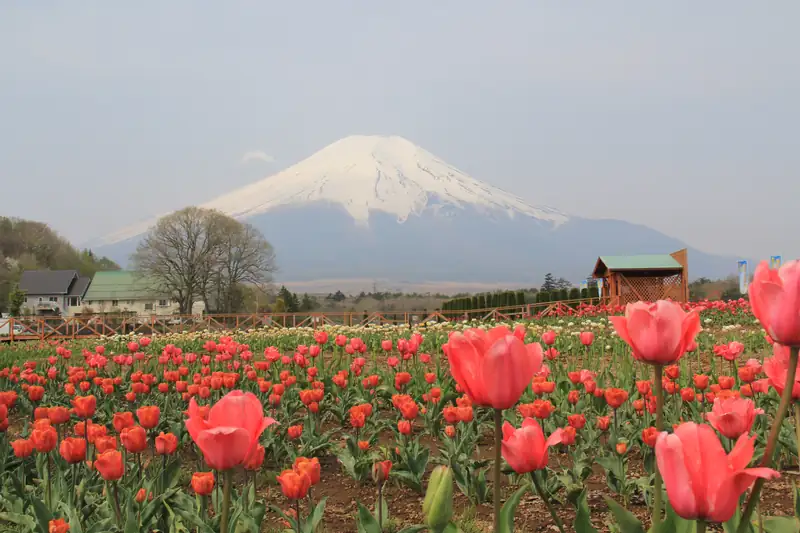
Red and pink tulips in a field at Hananomiyako Koen, with snow-capped Mount Fuji in the hazy distance

Hananomiyako Koen flower park

About 300,000 m² of flower fields with Fuji behind. The outdoor fields are free. The paid Seiryu no Sato zone, with a waterfall and a greenhouse, costs ¥600 for adults from mid-April to mid-October, less in spring and late autumn and nothing from 1 December to 15 March. Parking is ¥300 (checked October 2026).

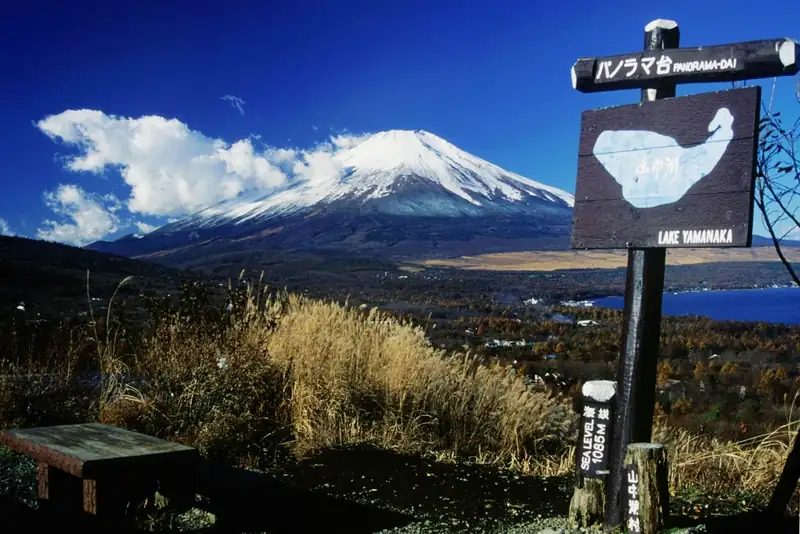
Snow-capped Mount Fuji and a corner of Lake Yamanaka seen from the Panorama-dai viewpoint, its signboard with a map of the lake on the right

Panorama-dai lookout

A roadside lookout on the road from Hirano towards Mikuni Pass, with the whole lake below Fuji. The prefecture rates it best from December to February. The car park holds about 7 cars and fills fast, and no bus stops at it: from the Mikuniyama Hiking Course entrance stop it is about 30 minutes on foot.

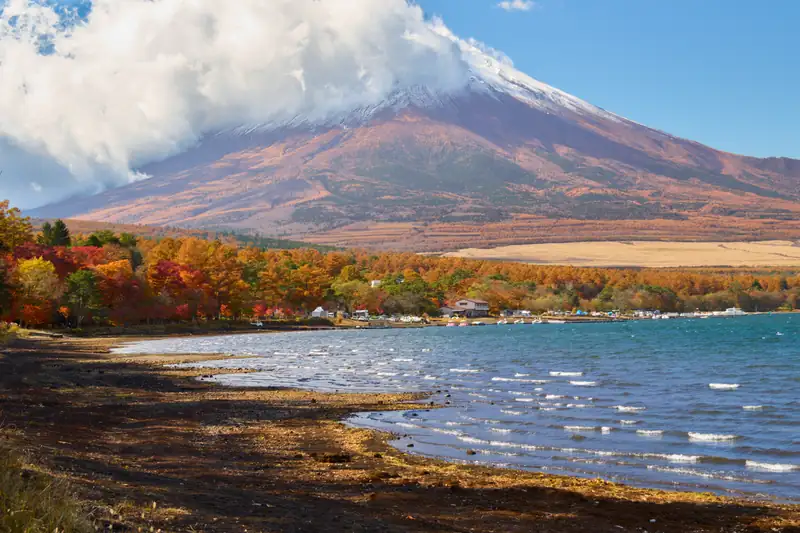
Mount Fuji partly in cloud above red and orange autumn trees along the shore of Lake Yamanaka, waves breaking on the beach

The lakeside path and bikes

A cycling road runs almost all the way round the shore. The tourism association suggests about 1 hour 30 minutes for the loop by bike, starting from the Forest of Literature park, and part of it follows the Tokyo 2020 Olympic road race route. The Asahigaoka shore on the south side has its autumn leaves festival from late October into November.

The pale stone Mishima Yukio Literary Museum building among pine trees and a brick path in the Forest Park of Literature

Mishima Yukio Literary Museum

Opened in July 1999 in the Yamanakako Forest of Literature park, after the village bought most of the Mishima family’s archive. Adults ¥700, 10:00 to 16:30, closed Mondays and Tuesdays (checked October 2026). The park also has a hall for the journalist Tokutomi Soho, who spent his summers here, and stones carved with poems.

The round, snow-dusted roof of the Ishiwari no Yu hot spring building in Yamanakako on a clear day

Onsen: Benifuji no Yu and Ishiwari no Yu

Benifuji no Yu, the public bath that looks at Fuji, is closed from 28 September 2026 until a planned reopening in March 2027. Ishiwari no Yu in Hirano is the open alternative: strongly alkaline water, adults ¥900, 11:00 to 19:00, closed Thursdays (checked October 2026). It posted a notice about its October opening, so check its site before you go. Its baths have no Fuji view.

How to visit Lake Yamanaka

The lake is on the east side of the Fuji Five Lakes, between Gotemba and Kawaguchiko. After snow, winter tyres may be needed on the roads around it.

By bus from Tokyo
Fujikyu and Keio highway buses run from Busta Shinjuku to the lake in about 2 to 2.5 hours: ¥2,650, or ¥2,350 booked online (checked October 2026). All seats are reserved and sales open a month ahead. The Japan Rail Pass does not cover them.
By car
Leave the Higashi-Fuji Goko Road at the Yamanakako interchange; Routes 138 and 413 follow the shore. The tourism association puts it at about 1.5 hours from central Tokyo; expect more at weekends and in Golden Week.
From Kawaguchiko or Fujisan Station
Local buses take about 25 to 30 minutes from Fujisan Station and 30 to 40 minutes from Kawaguchiko. The Fujikko loop bus circles the lake and links it with Fujiyoshida and Oshino Hakkai; its area pass costs ¥1,800 for one day or ¥2,200 for two (checked October 2026).
On a day tour
Many Mt Fuji day trips from Tokyo stop at Hirano Beach on the north shore, for anything from 20 minutes to an hour.

Tours that stop at Lake Yamanaka

Day trips from Tokyo that include the lake, from a short stop for the swans to a day built around the swan boat or the KABA bus. The tours page lists all 19 tours that visit the lake.

Stops at Lake Yamanaka

Mt. Fuji Lake Yamanaka Tour: Kaba Boat, Swan Boat or Walk

10 hours

The only Tokyo day trip built around the lake itself: choose a ride on the KABA amphibious bus, a cruise on the swan-shaped boat or a shoreline walk from Hirano Beach, then visit Oshino Hakkai and Oishi Park.

Stops at Lake Yamanaka

Mount Fuji 9 Iconic Spots Tour Oshino Hakkai Oishi Park

4.8 (342 reviews)10 hours

The cheapest well-reviewed day trip from Tokyo, packing nine stops into one coach day, beginning with Fuji reflections at Hirano Beach on Lake Yamanaka and ending at the Chureito Pagoda.

Stops at Lake Yamanaka

Mt. Fuji Small Group Day Tour: Hotel Pickup/Private Option

10 hours

A newer nine-guest tour that gives Lake Yamanaka a 40-minute first stop, then 70 minutes at Oshino Hakkai with lunch, Oishi Park and the pagoda, leaving Tokyo Station at 07:30 or Shinjuku at 08:00.

Stops at Lake Yamanaka

Tokyo: Mt.Fuji Autumn Foliage Day Trip with Swan Boat Ride

9 hours

An autumn coach day that opens with an hour on the Lake Yamanaka swan boat cruise, then takes in the coloured leaves at Oshino Hakkai, Oishi Park or the Maple Corridor, and the Kubota Itchiku museum.

Stops at Lake Yamanaka

Lake Yamanaka: Mount Fuji Day Trip & Sumo Experience

8 hours

Spends about two hours at Lake Yamanaka, with a panorama viewpoint, a live sumo show at the Fujitaya venue and time at the swan shore, before Oshino Hakkai, Oishi Park and the Hikawa clock shop street.

Stops at Lake Yamanaka

Tokyo: Mt Fuji, Oshino Hakkai,Chureito Pagoda,Lake Kawaguchi

4.8 (146 reviews)10 hours

A coach day that does the Kawaguchiko photo spots and an hour at Oshino Hakkai first, then finishes with 20 minutes beside Lake Yamanaka feeding the swans before the drive back.

Prices and ratings were taken from GetYourGuide and can change. Booking through these links supports this site at no extra cost to you.

See all Lake Yamanaka and Mt Fuji tours

Where to stay at Lake Yamanaka

Asahigaoka on the south shore suits a first stay without a car: the bus terminal, the swan boat pier, the KABA bus and the lakeside park are all within a few hundred metres. The Yamanaka district on the west side has the Fuji-view hotels and budget lodges near the main road. Hirano and Nagaike in the northeast are quieter, with fewer buses. Kawaguchiko has the most hotels and restaurants and trains from Shinjuku, but it is the most crowded of the five lakes and about 40 minutes from Asahigaoka by bus.

  • Hotel Mt. Fuji: on a hilltop above the northwest shore, with lake and Fuji views from the rooms and an open-air bath. Free shuttle from the bus stop, booked ahead.
  • PICA Yamanakako: cottages and a camping area about 100 m from the Asahigaoka bus terminal; dogs welcome.
  • Hotel Seikei: a hotel about 200 m from the shore at Asahigaoka, near the bus terminal. It has no website of its own, so this links its Booking.com page.
  • Family Lodge Hatagoya Yamanakako: a budget lodge in the Yamanaka district with rooms for up to six and free parking, about 1 km from the lakeside.

Nearby: Oshino Hakkai, Kawaguchiko and the Fuji Five Lakes

Yamanaka sits at the east end of the five lakes. These are the sights most day trips pair it with.

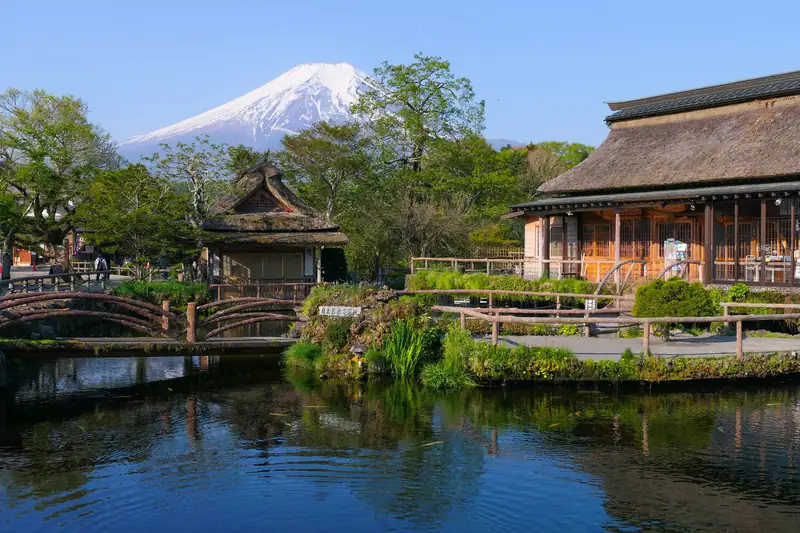
Clear spring-fed pond at Oshino Hakkai with thatched-roof buildings, trees and snow-capped Mount Fuji in the distance

Oshino Hakkai

Eight spring-fed ponds of Fuji snowmelt in Oshino village, about 10 km away. Fuji pilgrims purified themselves here, and the ponds are part of the World Heritage site too.

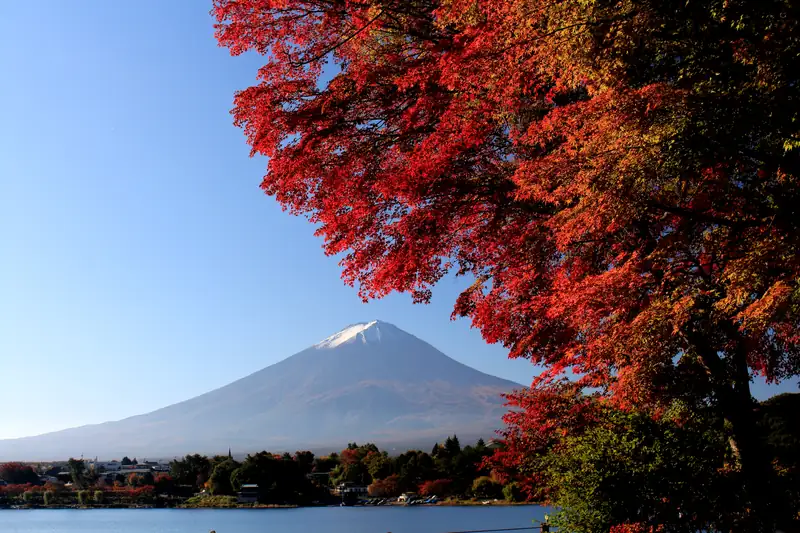
Red autumn maple leaves framing Mount Fuji with a dusting of snow, seen across Lake Kawaguchi

Lake Kawaguchiko

The most developed of the five lakes and the area’s transport hub, about 15 km west by road.

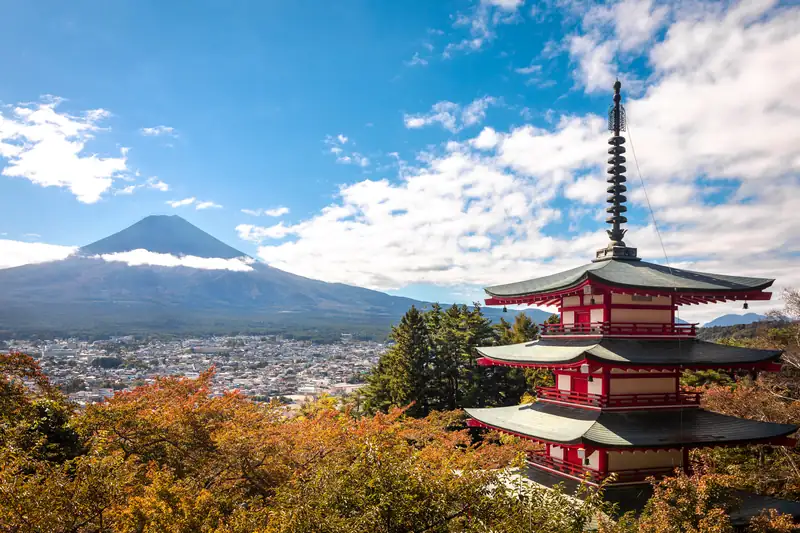
The red five-storey Chureito Pagoda among autumn trees, with Fujiyoshida city and Mount Fuji behind

Chureito Pagoda

The pagoda above Fujiyoshida, about 25 minutes by car. Fujiyoshida cancelled its 2026 cherry blossom festival over crowding; the park stays open.

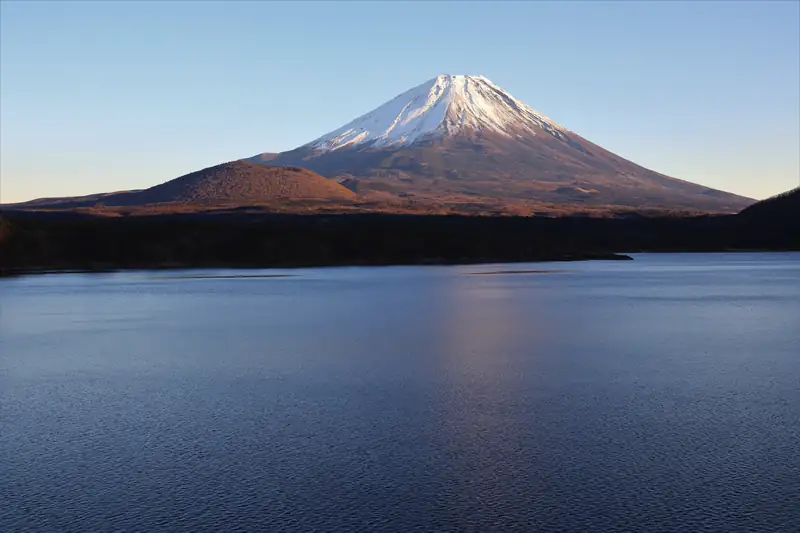
Mount Fuji lit by late-afternoon sun above the calm, dark blue water of Lake Motosu

The Fuji Five Lakes

Yamanaka, Kawaguchiko, Saiko, Shojiko (the smallest) and Motosuko (the deepest, whose Fuji view was on the old ¥1,000 note).

Lake Yamanaka guides

The lake’s own sights, from Diamond Fuji to the flower park and the onsen.

Plan your trip

Where to stay, how to get there from Tokyo and which day trips are worth it.

Mount Fuji above Lake Kawaguchi with red autumn maple leaves in the foreground

Tokyo to Mt Fuji by bus, train, tour or car

The cheapest and most frequent way from Tokyo to Mt Fuji is the Fujikyu or Keio highway bus from Busta Shinjuku to Kawaguchiko: 56 a day, about 1 h 45, from ¥2,000 paid online.

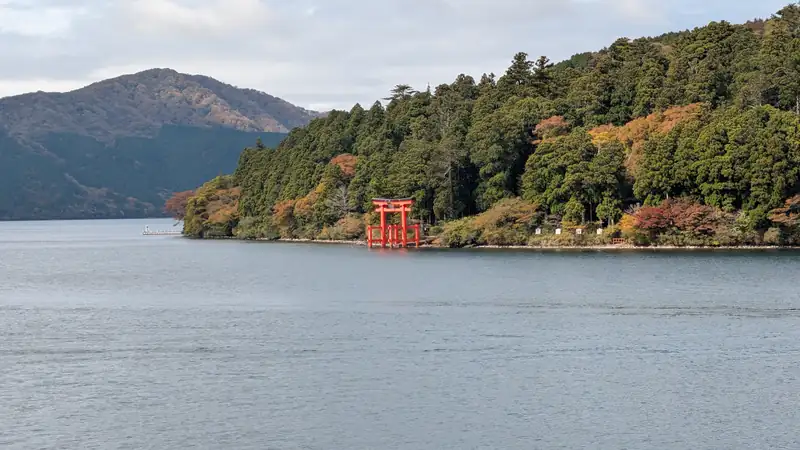
Lake Ashi in Hakone with the red Peace Torii of Hakone Shrine standing at the water's edge

Hakone vs Kawaguchiko: which to choose

Choose Kawaguchiko if seeing Mt Fuji up close is the point: the mountain stands across the lake, about 17 km away, and the bus from Shinjuku takes about 1 h 45.

Mt Fuji and Fuji Five Lakes

The sights around the mountain, and when and where to see it clear.

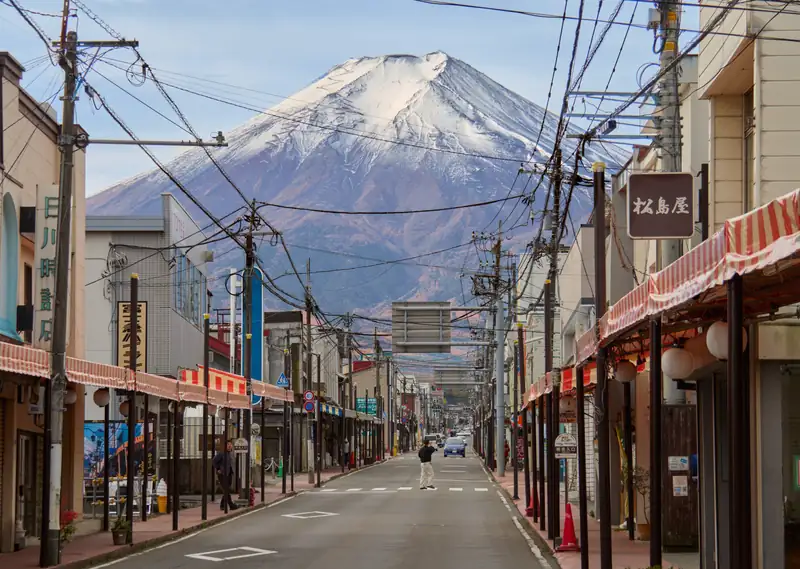
A shopping street in Fujiyoshida with snow-capped Mt Fuji at the end of the road

19 things to do near Mt Fuji

The best things to do near Mt Fuji are around the Fuji Five Lakes: watch Fuji from Lake Yamanaka's north shore, ride the KABA amphibious bus, walk Oshino Hakkai's spring ponds, climb to the Chureito Pagoda, visit Kitaguchi Hongu Fuji Sengen Shrine and Nenba's thatched village, and drive to the 5th Station.

Lake Yamanaka questions

Is Lake Yamanaka worth visiting?

Yes, if you want Mt Fuji across open water. It is the largest of the Fuji Five Lakes and part of the Fujisan World Heritage site, with the swan boat, the KABA amphibious bus, a flower park and a cycle path round the shore. Come between late autumn and winter for the clearest views; in summer Fuji is often hidden.

Is it allowed to swim in Lake Yamanaka?

This guide could not confirm it either way. Wikipedia lists swimming among the lake’s activities, but no page from the village or the tourism association that says so could be found. The lake is used for sailing, windsurfing, wakeboarding and fishing. Ask the Yamanakako Tourist Association (0555-62-3100) before you go in.

How do I get to Lake Yamanaka?

By highway bus from Shinjuku in about 2 to 2.5 hours, by car through the Yamanakako interchange on the Higashi-Fuji Goko Road (about 1.5 hours from central Tokyo in light traffic), or by local bus from Fujisan Station or Kawaguchiko Station in 25 to 40 minutes. Many Mt Fuji day tours from Tokyo also stop at the lake.

How far is Lake Yamanaka from Mount Fuji?

About 12 to 13 km in a straight line from the south and west shores to the summit, measured on a map; there is no official figure. The local tourism association calls Yamanaka the closest lake to Mt Fuji. No climbing trail starts at the lake: the nearest are the Subashiri and Yoshida trails.

Can you see Fuji from Lake Yamanaka?

Yes, on clear days, from almost anywhere on the shore. The north shore around Nagaike and Hirano and the Panorama-dai lookout are the best-known viewpoints. Fuji is often in cloud, far more in summer than in winter: Fuji City, on the south side of the mountain, counted it fully visible at 8 am on 22 days in February 2025 but on 2 in June. Mornings are clearer than afternoons.

How do I go from Tokyo to Lake Yamanaka?

Take a Fujikyu or Keio highway bus from Busta Shinjuku: about 2 to 2.5 hours, ¥2,650 or ¥2,350 booked online (checked October 2026), with all seats reserved. Or take the JR Chuo Line to Otsuki, the Fujikyu Line to Fujisan Station and a local bus, about 2 hours 45 minutes in all. By car it is about 1.5 hours in light traffic.